 Posted by
The crinoline, the cage of metal hoops that from the mid-19th century widened women’s skirts, was extremely flammable. It is estimated that between the late 1850s and the late 1860s it caused about 3,000 deaths in England alone. Its victims included Longfellow’s wife and two half-sisters of Oscar Wilde.
The crinoline was a cage-like structure worn under skirts to hold them up and make them wider. But this fashion cost thousands of women their lives: according to some estimates about 3,000 in England alone, and according to one calculation of the time almost 40,000 worldwide.
The crinoline
This accessory was very fashionable in the 19th century and was used to make petticoats and dresses very wide. Having a crinoline was essential to be in fashion, and every woman wanted one.
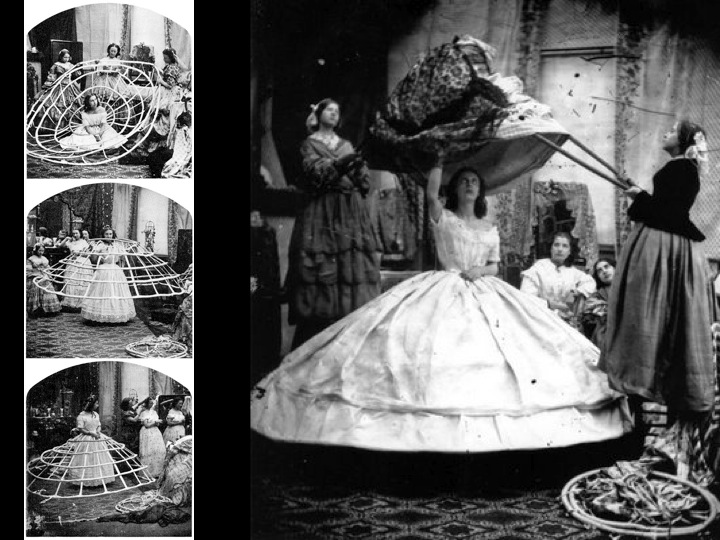
The crinoline takes its name from the horsehair (crine in Italian, crin in French) used at the time to make the thick, fluffy petticoats that gave volume to dresses. In 1856, however, the cage crinoline appeared, which ended up replacing them and took over the name. It consisted of a series of hoops made of metal or wicker and was used to emphasise a narrow waist.
The corset was also fashionable at the time, even though doctors kept warning against it for its harmful effects. The corset narrowed the waist, and women wanted to accentuate this by pairing it with wide, bell-shaped skirts. Sermons against these “immodest” skirts only made them more desirable.
Death by crinoline
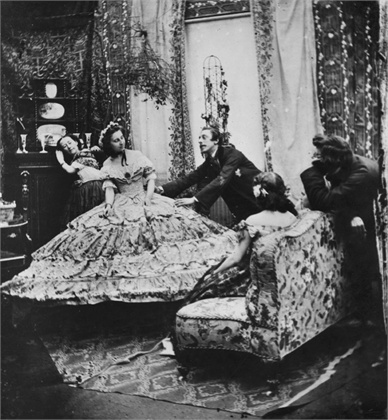
But why would this simple accessory be so dangerous? It certainly did not squeeze the ribcage like the dangerous corset. It was extremely bulky, and sitting down without the crinoline flipping outwards and exposing the lady’s charms was quite a feat. Not to mention getting through doorways.
What made it dangerous, though, was that the crinoline was extremely flammable. And it was this feature that led to the deaths of some 3,000 women.
In 1858 a woman died in Boston when her crinoline caught fire because she was standing too close to the fireplace. She burned to death in a few minutes. Five years later the same fate befell Margaret Davey, a 14-year-old maid who died of her burns. In England 19 “crinoline deaths” were recorded in just 2 months.
One of the biggest problems in trying to save the victims was that, if only other women were present, they did not dare go near for fear of catching fire themselves.
Not only in England but also in the United States, deaths from burning crinolines were high. In a single incident 9 ballerinas died when the skirt of one of them passed close to a candle, setting fire to all those near her. Crinolines also sometimes got caught in wheels and machinery, causing trouble and occasionally injuries.
In 1864 the Bulgarian writer Petko Slaveykov went so far as to estimate that over the previous 14 years at least 39,927 women worldwide had died because of burning crinolines: probably an inflated figure, but one that gives an idea of how common these tragedies were.
Among the most famous victims are Fanny Longfellow, wife of the poet Henry Wadsworth Longfellow, who died in 1861 after her dress caught fire, and Emily and Mary Wilde, half-sisters of Oscar Wilde, who on Halloween night 1871, at a party in Ireland, caught fire one after the other, the second while trying to save the first. Both died after days of agony.
🦋 Emadion lives through its readers. If this story kept you up at night, buy me a coffee: it helps me bring you the next nightmare.
☕ Support Emadion on Ko-fi