 Posted by
The Hope Diamond is famous not only for having belonged to kings and queens, but also for the terrible curse that, according to legend, strikes anyone who owns it: violent deaths, madness, suicides, financial ruin. But how much of it is true?
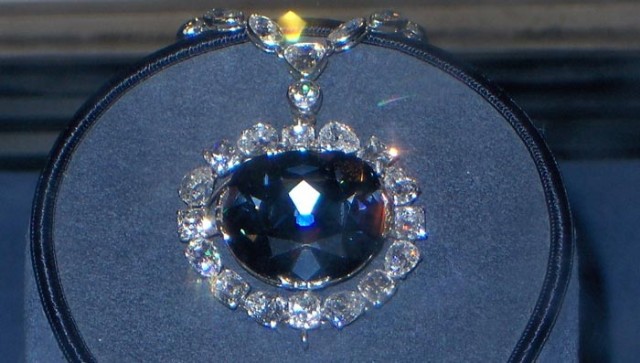
The Hope Diamond is a 45.52-carat blue diamond extracted in the 17th century from the Kollur mine in India. Bought by Jean-Baptiste Tavernier in 1666, it belonged to the kings of France, was stolen in 1792 and resurfaced in London, where it took the name of the Hope family. Since 1958 it has been on display at the Smithsonian in Washington. Its “curse” was largely invented by newspapers and jewellers in the early 20th century.
From India to France

The diamond’s documented history begins in 1666, when French merchant Jean-Baptiste Tavernier bought it rough in India. It probably came from the Kollur mine, in today’s Andhra Pradesh, then part of the Golconda kingdom. It weighed more than 115 carats. In 1668 Tavernier sold it to King Louis XIV of France along with hundreds of other diamonds.
According to legend, however, Tavernier did not buy it at all: he tore it from the eye of a statue of the goddess Sita in an Indian temple, and the priests cursed whoever possessed it. It was also said that Tavernier had been torn apart by wolves, or by wild dogs in Constantinople. In fact Tavernier died of natural causes in Moscow, aged 84.
In 1678 Louis XIV had the stone cut by the court jeweller Jean Pitau, producing a diamond of about 67 carats listed in the royal inventories as the “Blue Diamond of the Crown of France”. English-speaking historians simply call it the “French Blue”. Louis XV later had it set in a sumptuous jewel of the Order of the Golden Fleece.
The stone was also blamed for the misfortunes of many courtiers: the fall from favour of Madame de Montespan, Louis XIV’s mistress, and of finance minister Nicolas Fouquet, the guillotine for Louis XVI and Marie Antoinette, the horrific death of the Princesse de Lamballe during the Revolution. But none of them has a documented direct link with the diamond.
Theft and reappearance

In September 1792, in the middle of the French Revolution, the Crown Jewels were stolen from the Garde-Meuble, the royal storehouse in Paris. The blue diamond vanished. It was recut by persons unknown, probably to make it unrecognisable, and resurfaced in London: in 1812 it appeared in the records of diamond merchant Daniel Eliason. In 2007 a lead cast of the French Blue found in the Natural History Museum in Paris, with a label linking it to “Mr. Hope of London”, helped reconstruct those mysterious years. And in 2005 a Smithsonian study confirmed that the Hope Diamond was cut from the French Blue.
The stone entered the collection of banker Henry Philip Hope and appeared in a family catalogue in 1839: it has borne their name ever since. It later passed to Lord Francis Hope, who in 1894 married the American singer May Yohé. The marriage ended badly, and Lord Francis, deep in debt, obtained permission to sell the diamond in 1901. In the following years May Yohé tried to exploit the diamond’s story to relaunch her career, blaming it for her misfortunes and even backing a film, The Mystery of the Hope Diamond, which added new invented characters to the legend.
The invented victims
It was in the early 20th century that the curse really took off, thanks to the newspapers. In 1908 The Washington Post ran a headline saying the diamond had brought trouble to all who owned it, and in 1911 The New York Times published a long list of victims. Here are the names still found on many websites: jeweller Jacques Colot, who supposedly went mad and took his own life; the Russian prince Kanitovski, who supposedly killed his lover, the actress Lorens Ladue, and was then stabbed by revolutionaries; the Greek jeweller Simon Montharides, thrown over a precipice with his wife and child; the diamond cutter Wilhelm Fals, robbed by his son Hendrik, who later killed himself.
The problem is that almost none of these people ever existed, or at least had anything to do with the diamond. Colot was indeed a French diamond dealer of the period, but there is no record of any link with the stone. Even the Ottoman sultan Abdul Hamid II, who supposedly lost his throne because of the diamond, may never have owned it: the catalogue of the 1909 auction at which it was sold actually stated that it was one of only two gems in the collection never owned by the sultan.
According to many historians, the idea of a cursed gem torn from an idol was inspired by Wilkie Collins’s 1868 novel The Moonstone. And some suspect that jeweller Pierre Cartier himself embellished the story with macabre details to persuade his wealthy American client to buy it.
Evalyn Walsh McLean

That client was Evalyn Walsh McLean, a mining heiress and wife of Washington Post owner Edward McLean. She bought the diamond from Cartier in 1911 and wore it constantly, at parties and social events: it is said that she sometimes even put it around the neck of her Great Dane, Mike. She did not put much stock in the curse, and in fact added a few details of her own invention, such as the idea that the diamond had belonged to Catherine the Great.
Yet her life was marked by many tragedies. Her son Vinson died as a child, hit by a car; her husband, an alcoholic, ended his days in a psychiatric hospital; her daughter died young in 1946 of an overdose. Evalyn died in 1947, aged 60, and her jewels were sold to pay her debts.
The diamond today
In 1949 the diamond was bought by New York jeweller Harry Winston, who did not believe in curses. On 10 November 1958 he donated it to the Smithsonian in Washington by simply mailing it, in a box wrapped in brown paper, as registered mail insured for a million dollars. Winston died of a heart attack in 1978, many years later.
Today the Hope Diamond is the most visited jewel at the National Museum of Natural History in Washington. It also has a feature that may have helped its sinister reputation: under ultraviolet light it glows an intense red, and keeps doing so for a while even after the light is switched off, because of the boron in the stone, the same element that gives it its blue colour. Since it has belonged to the Smithsonian, the museum says, it has brought nothing but good luck.
🦋 Emadion lives through its readers. If this story kept you up at night, buy me a coffee: it helps me bring you the next nightmare.
☕ Support Emadion on Ko-fi