
 Posted by
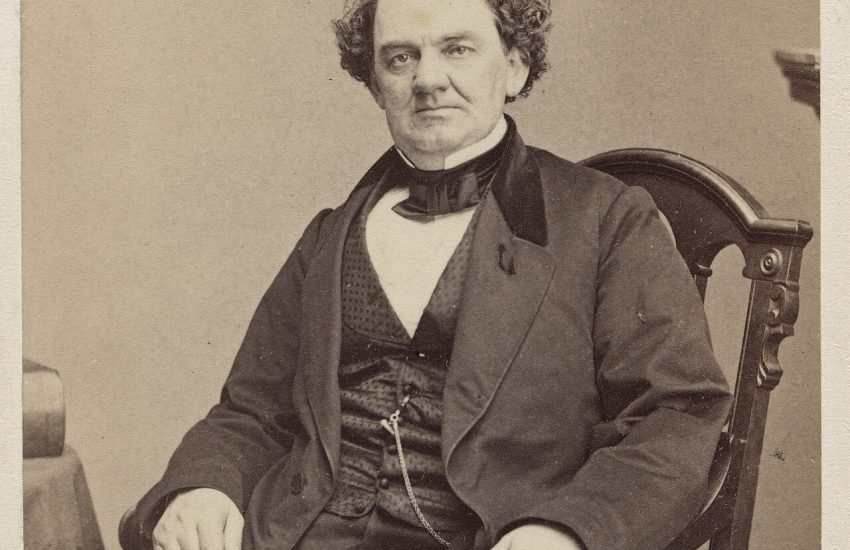
In the summer of 1842, New York went wild over a mermaid supposedly “caught near the Feejee Islands.” It was a shriveled object less than three feet long, made in a Japanese workshop, passed through Batavia and London, and finally leased by America’s boldest showman, Phineas Taylor Barnum. Behind it lay fake letters, a fake scientist and a carefully staged publicity campaign. Modern scans of similar specimens have revealed what these creatures were really made of.
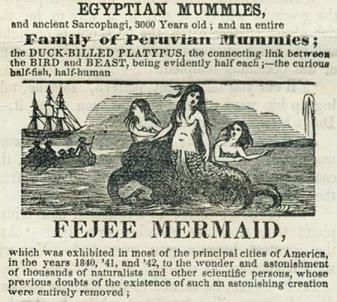
The posters promised a sea maiden with flowing hair, bare breasts and a shimmering tail. What paying customers actually found was a small, dark, wrinkled body, its mouth gaping over bared teeth and its arms thrown up toward its face, as if it had died screaming. Years later Barnum himself called it an ugly, dried-up little thing that looked as though it had perished in great agony.
The disappointment didn’t stop anyone. Quite the opposite. The “Feejee Mermaid” became one of the most talked-about attractions of nineteenth-century America, and its name survives today as the generic label for every fake mermaid sitting in a sideshow, a museum case or the back of a curiosity shop.
📍 This story is on the Mystery Map: see where it happened →
Made in Japan, sold for a fortune
The story begins far from America. In Japan, between the eighteenth and nineteenth centuries, ningyo (“human-fish”) were creatures of folklore, and their supposed remains were kept in some temples or shown at misemono, popular fairs where all kinds of marvels were put on display. Skilled craftsmen built these beings out of papier-mâché, wood, clay and fish parts. During Japan’s period of isolation, the only window onto the West was Dejima, the artificial island in Nagasaki Bay where Dutch traders worked, and from there some of these objects made their way overseas.
One of them ended up with an American sea captain, Samuel Barrett Eades. According to the best-documented account, in January 1822 Eades bought it from Dutch merchants in Batavia, today’s Jakarta, for $6,000: an enormous sum, which he took from the funds of a ship he only partly owned. In his autobiography Barnum told a different version, with a purchase in Calcutta in 1817. On one point the sources agree: Eades was convinced he was holding the fortune of a lifetime.
London, 1822: the first unmasking
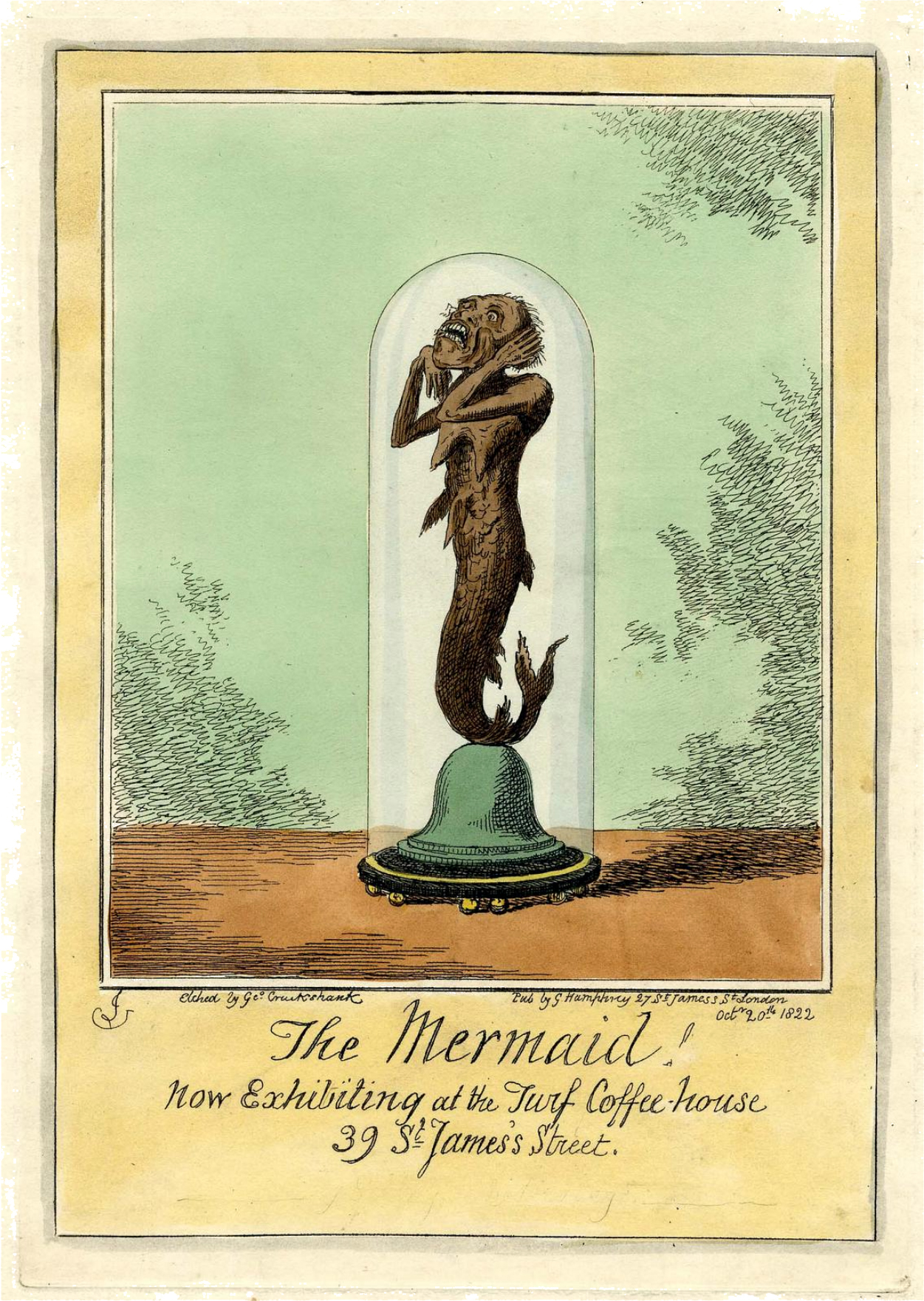
In September 1822 the mermaid reached London and went on show at a coffee house on St. James’s Street. The caricaturist George Cruikshank made an etching of it, and for a few weeks the crowds came. But British naturalists saw through the trick quickly. William Clift of the Royal College of Surgeons examined it and concluded it was a salmon joined to the torso and skull of an orangutan, with the jaw of a baboon. That verdict is the origin of the “monkey sewn to a fish” idea that has been repeated for two centuries.
For Eades it was the beginning of ruin. The ship’s co-owner sued him, and the court ordered him to repay the money by working without wages. The captain spent the following years at sea and never cleared the debt. When he died, the mermaid passed to his son, who sold it for a fraction of the original price.
Kimball meets Barnum
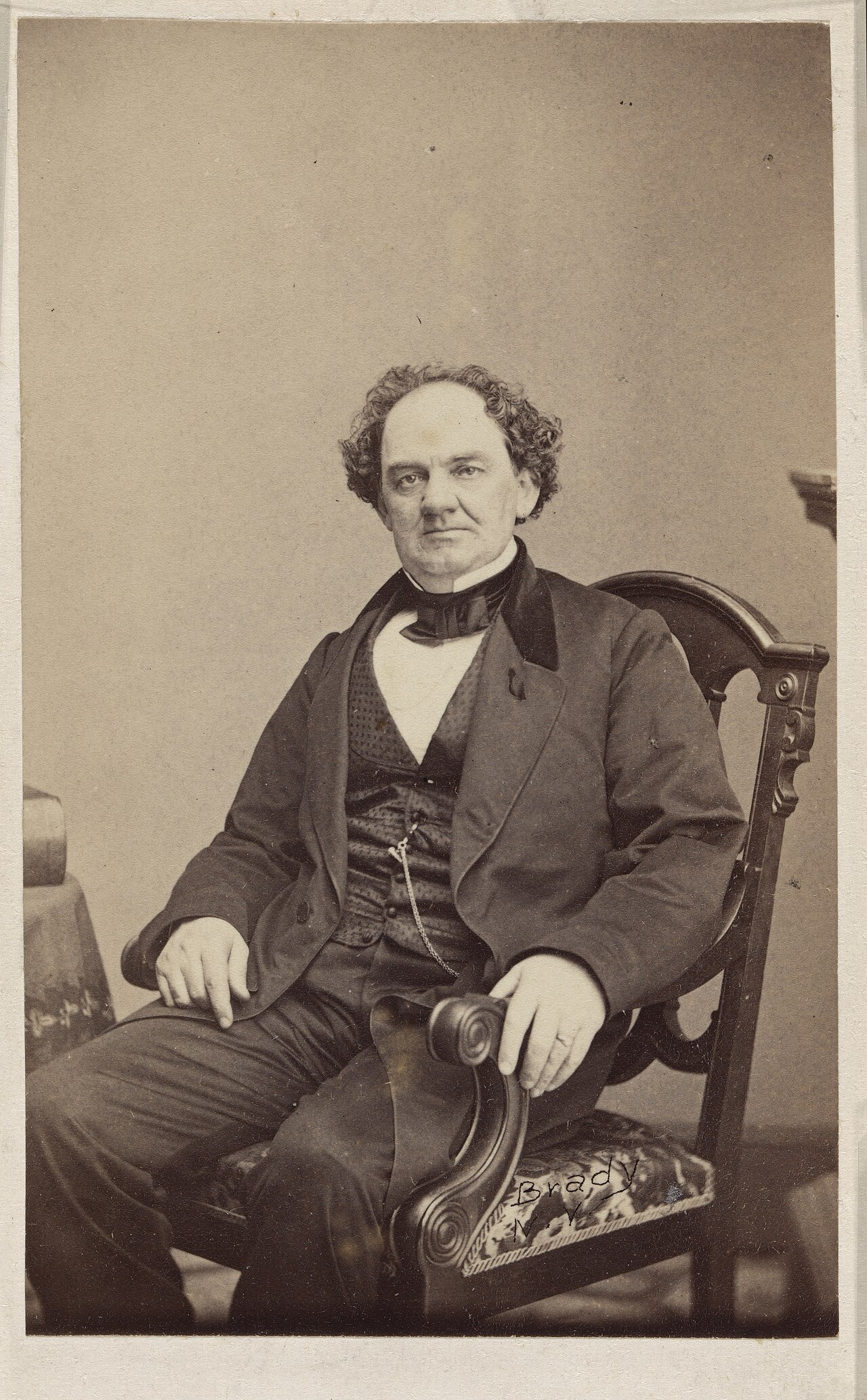
The buyer was Moses Kimball, owner of the Boston Museum. In the summer of 1842 Kimball brought the creature to New York to show it to Barnum, who had recently taken over the American Museum at the corner of Broadway and Ann Street. Barnum had it examined by a naturalist he trusted. The expert admitted he couldn’t tell how it had been made, but when asked why he was sure it was fake, he answered with disarming simplicity: “Because I don’t believe in mermaids.”
That was enough for Barnum. He didn’t care whether the mermaid was real; he cared whether the public could suspect it might be. He leased the object from Kimball, who remained its owner, and started laying the groundwork.
The doctor who never existed
Over the following weeks, New York newspapers received letters from Montgomery, Alabama, from Charleston and from Washington. They described a certain Dr. J. Griffin of a “Lyceum of Natural History” in London, who was travelling with a genuine mermaid caught near the Feejee Islands. Years later Barnum confessed that he had written the letters himself and had friends mail them on the right dates.
Dr. Griffin, of course, did not exist. The name hid Levi Lyman, one of Barnum’s associates. Lyman checked into a Philadelphia hotel and, as if out of gratitude, showed the mermaid to the landlord, who in turn showed it to friends, some of them newspapermen. The word spread exactly as planned.
On Sunday, July 17, 1842, several New York papers ran woodcuts of a beautiful, half-naked mermaid: Barnum had offered the same picture to each editor as if it were an exclusive. At the same time he had ten thousand pamphlets about mermaids handed out across the city, full of alluring creatures that bore no resemblance to the real object.
Crowds on Broadway
“Griffin” exhibited the mermaid for a week at Concert Hall on Broadway, lecturing on his theories: if the sea holds sea horses, sea lions and sea dogs, why not sea people too? Then the creature moved to the American Museum, where it stayed on view for about a month at no extra charge. People poured in, argued, got indignant and came back with friends. Whether it was real almost stopped mattering.
The success led Barnum to send it on a tour of the South, in the care of his uncle Alanson Taylor. In Charleston, however, the mermaid landed at the center of a furious newspaper war: the editor of the Charleston Courier defended its authenticity, while the Rev. John Bachman, an amateur naturalist, denounced it in the Mercury as a crude Yankee humbug and even threatened to destroy it. The tour was cut short and the mermaid shipped back to New York.
A vanished mermaid
For some twenty years the creature shuttled between Kimball’s museum in Boston and Barnum’s in New York, with a trip to London in 1859. Then the trail goes cold. Barnum’s American Museum burned down in 1865, but according to the most careful reconstructions the mermaid should have been in Boston at the time. The likeliest theory is that it was lost in a fire at Kimball’s museum some decades later.
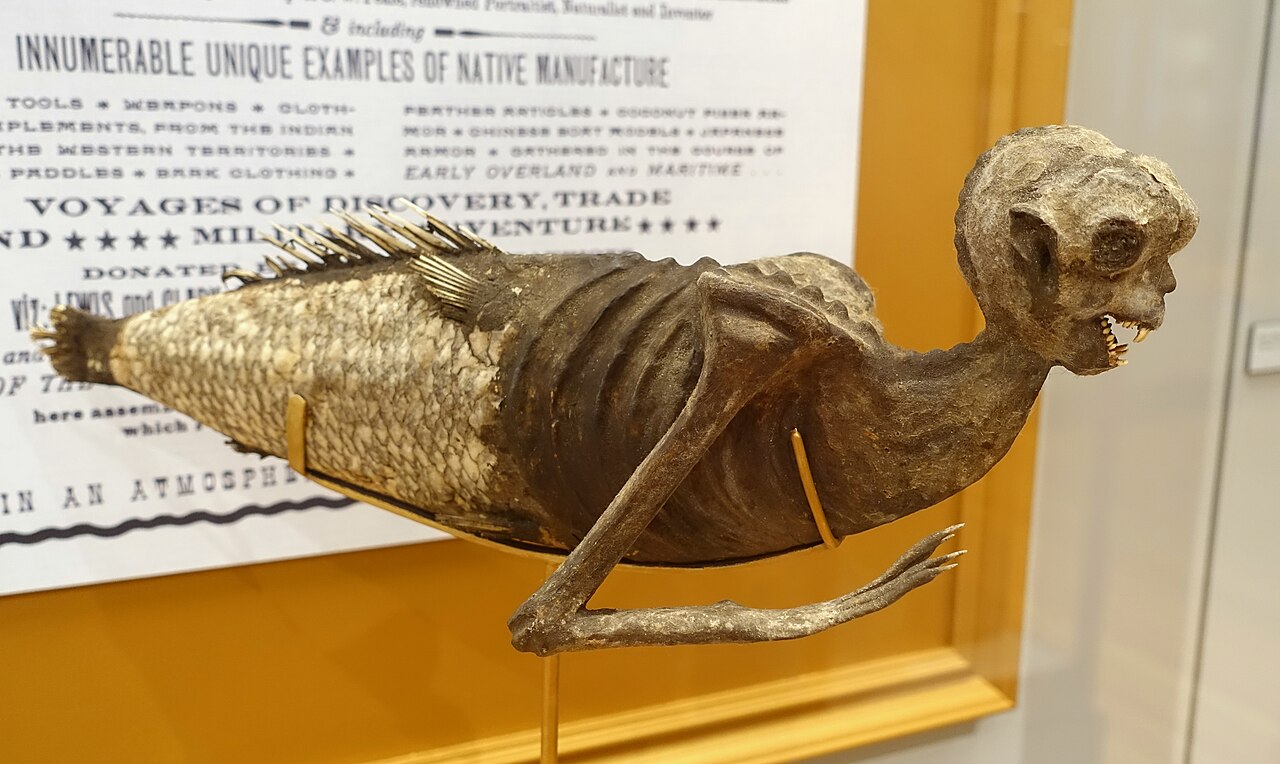
Harvard’s Peabody Museum holds a small papier-mâché mermaid from the Kimball collection, donated by his heirs. Some have wondered whether it is the original, but it is smaller and far cruder than the nineteenth-century descriptions: most likely it is another piece from the same menagerie of marvels.
What’s inside a mermaid
Modern science has looked inside some of these creatures, with surprising results. In 2014 the Horniman Museum in London put its “Japanese monkey-fish,” bought at auction in 1919, through X-rays and CT scans. There was no monkey at all: the frame was a wooden stick, a bundle of string, clay and papier-mâché, with scales resembling those of the carp family and teeth like a wrasse’s. Curator Paolo Viscardi noted that none of the Japanese ningyo he had examined contained primate remains, and that papier-mâché (hariko) was a widespread craft in Japan.
In 2022 and 2023 a team from Kurashiki University of Science and the Arts studied the roughly 30-centimeter “mermaid mummy” kept at Enjuin temple in Asakuchi, Okayama Prefecture. Tradition held that it had been caught off Tosa in the eighteenth century. The analysis found cloth, paper, cotton, a plaster-like material, pufferfish skin and the scales of a croaker, with no skeleton apart from a jaw. Dating placed it in the second half of the 1800s. The temple chose to keep caring for it with respect.
The art of being fooled
The Feejee Mermaid was never a mystery to the people who made it, nor to Barnum. The real mystery lies elsewhere: why did thousands of people line up to see an object the newspapers had already described as hideous and suspicious? Perhaps because, at least for the price of a ticket, the idea that the sea still hid something unknown was worth more than the truth.
Today dozens of “Fiji mermaids” rest in museum cases around the world, arms raised and mouths open. They are not sea creatures, but something perhaps more interesting: a dried-up portrait of our hunger for wonder.
If strange beings displayed as relics fascinate you, read about the Jenglot, the Indonesian vampire mummy and the Zuiyo-maru carcass.
🦋 Emadion lives through its readers. If this story kept you up at night, buy me a coffee: it helps me bring you the next nightmare.
☕ Support Emadion on Ko-fiSources
- Fiji mermaid, Wikipedia
- Alex Boese, The Feejee Mermaid, Museum of Hoaxes
- Barnum on the Fejee Mermaid (from his 1855 autobiography), The Lost Museum, CUNY
- Jessie Szalay, The Feejee Mermaid: Early Barnum Hoax, Live Science (2016)
- Paolo Viscardi, Manmade Mermaids, Horniman Museum and Gardens (2014)
- Mermaid mummy stored at Japanese temple has true identity revealed, SoraNews24 (2023)
- ‘Mermaid’ mummy worshipped in Japan found to be a doll with fish parts, The Jerusalem Post (2023)
Images: P. T. Barnum (Mathew Brady Studio, public domain); etching by George Cruikshank, 1822 (public domain); Feejee Mermaid advertisement, 1842 (public domain); Peabody Museum mermaid (photo by Daderot, public domain). All from Wikimedia Commons.