
 Posted by
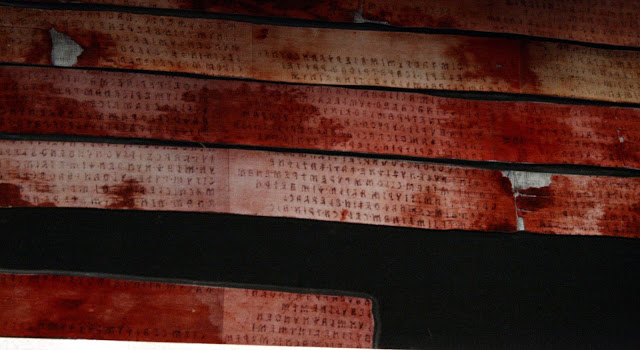
- What it is: the Liber Linteus Zagrabiensis, the “Linen Book of Zagreb”, the longest known Etruscan text.
- When: written around 250 BC, though the linen is even older.
- Where it is: at the Archaeological Museum in Zagreb, Croatia, in a refrigerated room.
- The mystery: it was used to wrap an Egyptian mummy.
- What it says: it is thought to be a religious calendar, but Etruscan is still not fully understood.
The Liber Linteus Zagrabiensis (Linen Book of Zagreb) is the longest Etruscan text ever found and the only linen book to have survived, perhaps the oldest European book in existence. It dates back to the 3rd century BC and, because so little is known about the Etruscan language, it is still largely untranslated today.
Discovery
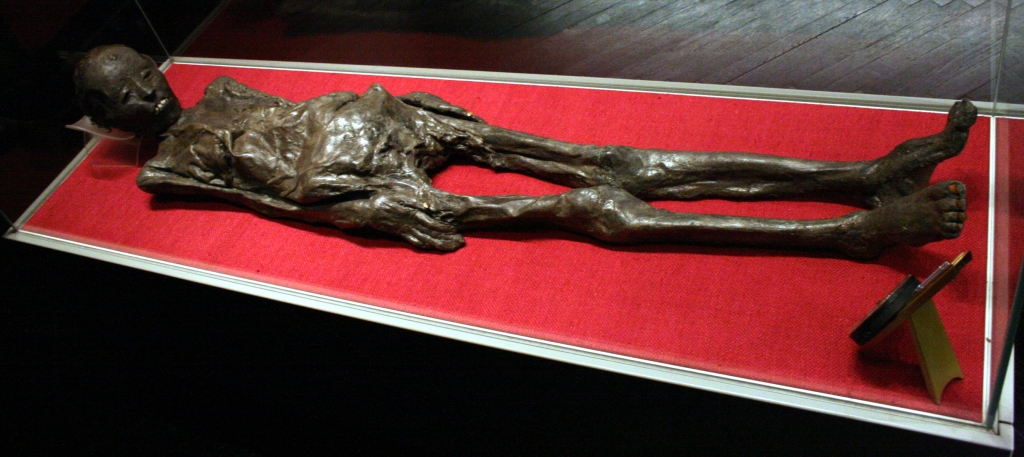
In 1848 a Croatian official in the Hungarian Royal Chancellery, Mihajlo Barić, resigned from his job and decided to travel the world. One of his stops was Egypt and, while he was in Alexandria, he bought as a souvenir a sarcophagus containing the mummy of a woman.
Back home in Vienna, Barić put the sarcophagus in his sitting room, standing upright in a corner, to show it to his guests.
The mummy was wrapped in linen bandages, which the official decided to remove and display in a separate glass case. But he never noticed the writing on the cloth and left it on display until his death in 1859, when it passed to his brother Ilija, a priest in Slavonia.
Ilija had no interest in the mummy and in 1867 he donated it to the National Institute of Croatia, Slavonia and Dalmatia in Zagreb, today’s Archaeological Museum. Its catalogue described it like this:
“Mummy of a young woman (with wrappings removed) standing in a glass case and held upright by an iron rod. Another glass case contains the mummy’s bandages which are completely covered with writing in an unknown and hitherto undeciphered language, representing an outstanding treasure of the National Museum.”
The first studies
That same year the mummy and the bandages were examined by German Egyptologist Heinrich Brugsch, who noticed the strange writing. But he thought it was hieroglyphs and did not look any further.
In 1877, however, Brugsch was talking about runes with the explorer and linguist Richard Burton, and this reminded him of the bandages he had examined years earlier: what he had seen was not hieroglyphs.
They realised the text might be very important but eventually concluded, wrongly, that it was the Egyptian Book of the Dead transcribed in Arabic script.
In 1891 the bandages were sent to Vienna, where they were examined more closely by Jakob Krall, an expert in Coptic, who expected the writing to be Coptic, Libyan or Carian. After careful study, in 1892, he realised it was Etruscan, and he was the one who put the strips of cloth back together.
But what were bandages with Etruscan writing doing in Egypt?
Theories
It was thought the mummy might be that of an Etruscan woman who had fled her homeland for some reason and ended up in Egypt, where she died and was buried in bandages bearing writing in her own language.
It was later found that the text was a religious calendar and that the mummy was actually an Egyptian woman.
A papyrus found in the sarcophagus, a Book of the Dead, identified her as Nesi-hensu, the wife of Paher-hensu, a tailor from Thebes. More recent studies, however, have shown that the papyrus is almost a century younger than the mummy, so it may not be her. The woman was between 30 and 40 when she died, wore a necklace and had traces of flowers and gold in her hair. Among the remains of her wreath there was even a cat’s skull.
The most likely explanation is simple: in Ptolemaic Egypt, the linen of the book was cut into strips and reused to wrap the mummy. And it is precisely thanks to this that it has survived to this day.
The bandages
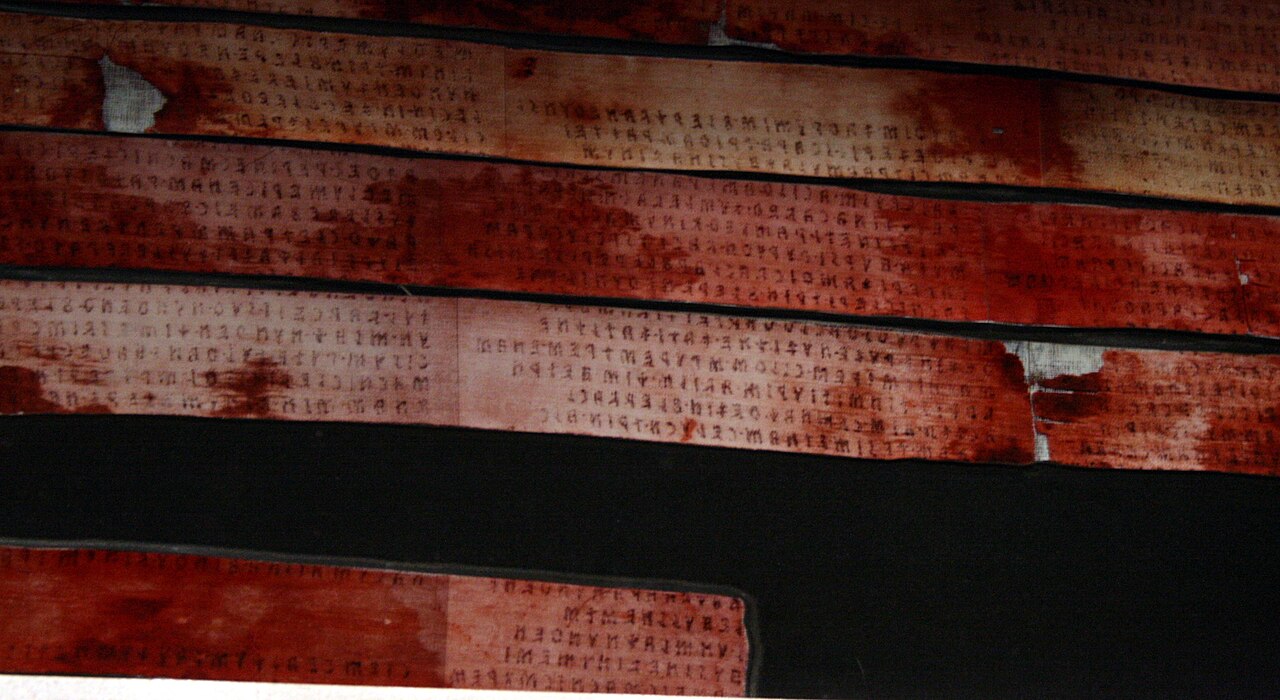
By analysing the text, thanks to the mention of some local gods, scholars concluded that it was written in a small area of south-eastern Tuscany, near Lake Trasimeno, where four major Etruscan cities stood: today’s Arezzo, Perugia, Chiusi and Cortona.
From the handwriting the text is dated to around 250 BC, but radiocarbon dating showed that the linen was woven even earlier, around 390 BC. It is made up of 12 columns, written from right to left, each representing a kind of page. Unfortunately most of the first three columns are missing and nobody knows how the “book” begins. Towards the end, on the other hand, the text is almost complete.
Altogether there are 230 lines of text with 1,330 legible words, but only about 500 distinct words or roots, written in black ink, while red is used for lines and marks. Instead of being rolled up like a papyrus, the book was folded so that the “pages” lay one on top of the other, like a modern book. Only about 60% of the text is thought to have survived.
Although the Etruscan language is still a great mystery, it has been possible to understand the main theme of the writing: dates and names of gods suggest a liturgical calendar, with the ceremonies and rites to be held on each day. In recent decades knowledge of Etruscan has grown considerably, and Dutch scholar L. B. van der Meer has published a word-by-word analysis of it. So is that the whole mystery, or does this mummy hide other secrets?
🦋 Emadion lives through its readers. If this story kept you up at night, buy me a coffee: it helps me bring you the next nightmare.
☕ Support Emadion on Ko-fi