 Posted by
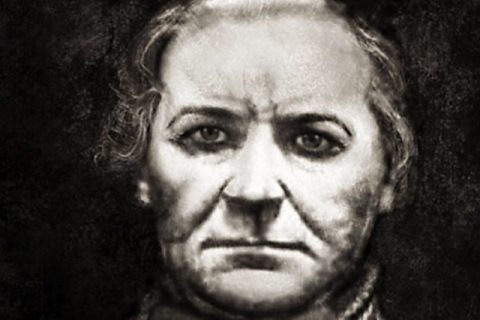
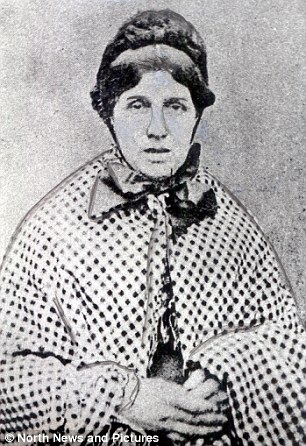
Mary Ann Cotton (1832-1873), born in County Durham, is considered the first female serial killer in British history. She was convicted of poisoning her stepson Charles with arsenic, but she is believed to have also killed 11 of her 13 children, three of her four husbands, her mother, a lover, a friend and several stepchildren, often to collect life insurance. She was hanged at Durham Gaol on March 24, 1873.
Mary Ann Cotton was an English serial killer, perhaps the first in British history, who is believed to have killed her mother, three husbands, a lover and 11 of her 13 children with arsenic. Her story has many similarities with the case of Nannie Doss.
Mary Ann Cotton
Mary Ann Robson was born on October 31, 1832 in Low Moorsley, County Durham, in the north of England. Her childhood was marked by poverty and unhappiness, but for a poor family in the 19th century these were the normal conditions of life.
When she was only nine, in February 1842, her father Michael, a colliery sinker at Murton, died falling about 46 meters down a mine shaft. His body was returned to his widow in a sack stamped “Property of the South Hetton Coal Company”, and since the cottage was tied to his job, the family risked ending up on the street.
The following year Mary Ann’s mother remarried another miner, George Stott, but the girl and her stepfather never got along. So at 16 she left home to work as a nurse in the house of a colliery manager, in the nearby village of South Hetton.
When the family’s children were sent to boarding school, she went back home and trained as a dressmaker. As a girl, according to her old Sunday school superintendent, she was a diligent child, always clean and tidy.
First husband
In 1852, at 20, Mary Ann married a miner, William Mowbray, in Newcastle upon Tyne. The couple moved to South West England for William’s work.
At her trial there was talk of four or five of the couple’s children dying young in those years. None of these deaths was registered, though: registration was compulsory, but the law was not enforced.
Back in the North East, William worked as a fireman on a steamer sailing out of Sunderland and then as a colliery foreman. Meanwhile children kept being born and dying: daughter Margaret Jane died in 1860 and little John Robert William in 1864, aged one, of “gastric fever”.
In January 1865 William too died suddenly of an intestinal disorder. Mary Ann had insured the lives of her husband and children with the British and Prudential: for William she collected £35, about six months’ wages for a laborer, and £2 5s for little John.
Second husband
Soon after William’s death, Mary Ann moved to Seaham Harbour, where she began a relationship with Joseph Nattrass, who however was engaged and married another woman. During that time the second Margaret Jane, aged three and a half, also died of typhus.
Of the nine children she had borne, only Isabella was left, and she sent her to live with her grandmother.
Back in Sunderland she found work as a nurse at the infirmary for contagious fevers. There she met a patient, engineer George Ward, and on August 28, 1865 they married at St Peter’s Church in Monkwearmouth.
But George kept getting sick and died on October 20, 1866, after a long illness with paralysis and intestinal problems. His death certificate said cholera and typhoid. The doctor later said he had been surprised by such a sudden death. Once again Mary Ann collected the insurance.
Third husband
In November 1866 Mary Ann found work as a housekeeper for James Robinson, a shipwright in Pallion, Sunderland, who had recently lost his wife Hannah and was left alone with his children.
A month after she arrived, James’s youngest child, John, died of gastric fever.
Devastated by grief, James sought comfort in Mary Ann’s arms, and she became pregnant. Soon after, though, she had to go back to Seaham Harbour: her mother had fallen ill with hepatitis.
The murder of her mother
Her mother soon began to recover, but then started complaining of severe stomach pains and died in the spring of 1867, aged 54, nine days after her daughter arrived.
Mary Ann then took Isabella with her to James’s house. There the girl fell ill and died of severe stomach pains, along with two of James’s children, Elizabeth and James. The three children were buried between late April and early May 1867. For Isabella, Mary Ann collected £5 10s 6d in insurance.
On August 11, 1867 Mary Ann and James married and in November their daughter was born, Margaret Isabella. Sadly she too died the following February. On June 18, 1869 another son, George, was born, but James began to suspect his wife, above all because of her insistence on insuring his life.
He then discovered that Mary Ann had run up £60 of debts behind his back, had stolen more than £50 she was supposed to bank, and was forcing his older children to pawn household valuables.
James threw her out, keeping little George, and Mary Ann ended up living on the street. James was the only husband to survive.
Fourth husband
Desperate, Mary Ann was helped by her friend Margaret Cotton, who introduced her to her brother Frederick, a pitman from Walbottle who had been widowed and had lost two of his four children. Margaret acted as a second mother to the two remaining boys, Frederick Jr. and Charles.
In late March 1870 Margaret too died of a mysterious stomach ailment.
Frederick, heartbroken, sought comfort in Mary Ann, who became pregnant again. On September 17, 1870 they married at St Andrew’s in Newcastle, even though Mary Ann was still married to James Robinson. Early in 1871 little Robert was born. Soon after, Mary Ann learned that her old flame, Joseph Nattrass, was living in West Auckland, about 50 kilometers away, and was no longer married.
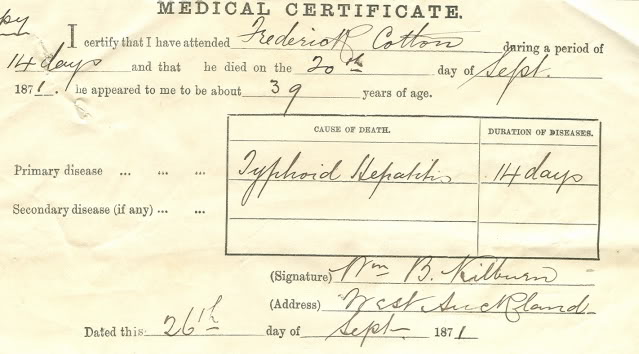
She rekindled the romance and persuaded the family to move near him. Frederick died in December of that year of “gastric fever”. Naturally, there was insurance on his life and on his sons’.
The two lovers
Widowed, Mary Ann took Joseph Nattrass in as a lodger and found work nursing an excise officer recovering from smallpox. Popular accounts call him John Quick-Manning, but there is no trace of that name in the records: he was probably a man named Richard Quick Mann. Mary Ann became pregnant by him, for the thirteenth time.
In March 1872 Frederick Jr. died, and soon after little Robert. Then Joseph too fell ill with gastric fever and died just after changing his will in Mary Ann’s favor.
Mary Ann Cotton’s last murder
Now only Charles Cotton was left. One day Thomas Riley, a parish official who was also West Auckland’s assistant coroner, asked Mary Ann to nurse a woman ill with smallpox. She complained that the boy was in her way and asked whether he could be sent to the workhouse. Riley replied that she would have to go too. Mary Ann refused and said the boy was sickly and would soon no longer be a problem:
“He’ll go like all the rest of the Cottons”.
Five days later Mary Ann told Riley that Charles had died. Riley went to the police and persuaded the doctor not to sign the death certificate until the circumstances were clear. The first person Mary Ann went to after the boy’s death was not the doctor but the insurance office. There she found out that without a death certificate she would get nothing.
An inquest was held and the jury returned a verdict of natural causes. Mary Ann said she had treated the boy with arrowroot and that Riley was accusing her because she had rejected his advances. But local newspapers latched onto the story and discovered that, moving around northern England, Mary Ann had lost three husbands, a lover, a friend, her mother and 11 children, all dead of “gastric fevers”.
Arrest and trial
The doctor who had attended Charles, William Byers Kilburn, had kept samples, and tests revealed arsenic. Mary Ann was arrested and the boy’s body was exhumed. The trial was postponed because on January 7, 1873, in jail, Mary Ann gave birth to her thirteenth and last child, whom she named Margaret Edith Quick-Manning Cotton.
The trial began on March 5, 1873 at the Durham Assizes. The prosecution was led by Charles Russell, who would later handle other famous poisoning cases. The defense argued that Charles had not swallowed the poison but inhaled it, because arsenic was used as a dye in the house’s green wallpaper. It also suggested that the chemist, distracted, had mistakenly used arsenic instead of bismuth, a powder used for diarrhea.
The jury retired and after just 90 minutes found Mary Ann Cotton guilty of the murder of little Charles. She was sentenced to death by hanging.
Execution
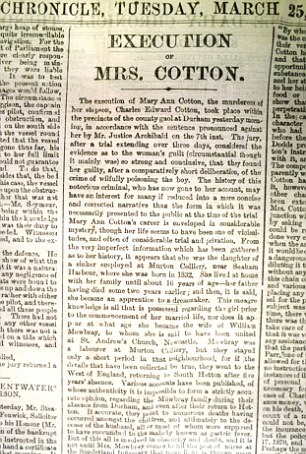
After the verdict, according to The Times correspondent, she was very shaken, but a few hours later returned to her usual cold, reserved manner, convinced she would receive royal clemency and still claiming to be innocent. Several petitions were presented to the Home Secretary, to no avail, and on March 24, 1873 she was led to the gallows at Durham County Gaol.
The hangman, William Calcraft, set the rope too short, possibly on purpose, and Mary Ann did not die instantly from a broken neck: she died slowly, strangled by the noose. Of her 13 children, only two survived her: Margaret Edith, who lived until 1954, and George, her son with James Robinson.
How could Mary Ann Cotton poison so many people without raising suspicion?
First of all, living conditions were not the best, especially for poor families, child mortality was extremely high and a death from intestinal problems raised no suspicion.
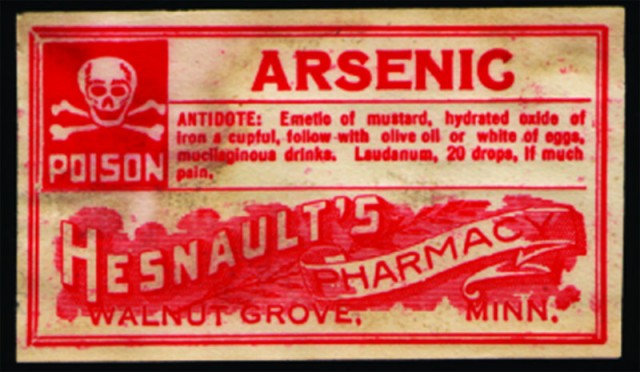
Secondly, arsenic was easily available at the time, because it was used as a disinfectant, and swallowing it caused vomiting and diarrhea.
Deaths from poisoning were therefore often mistaken for gastric fever or typhoid, diseases that attacked the intestinal system. On top of that, Mary Ann moved often, changing towns and doctors, and no one could connect the dots. Her story was told in 2016 in the British miniseries Dark Angel, starring Joanne Froggatt and inspired by criminologist David Wilson’s book “Mary Ann Cotton: Britain’s First Female Serial Killer“.
🦋 Emadion lives through its readers. If this story kept you up at night, buy me a coffee: it helps me bring you the next nightmare.
☕ Support Emadion on Ko-fi