 Posted by
On March 2, 1879 in Richmond, London, Irish maid Kate Webster killed her employer, the widow Julia Martha Thomas, then dismembered and boiled the body, throwing the remains into the Thames. For two weeks she posed as her. She was hanged on July 29, 1879. The victim’s head was found only in 2010, during building works at an old pub bought by David Attenborough.
The murder of Julia Martha Thomas was one of the most famous and closely followed of the nineteenth century, so much so that the newspapers of the time called it “the Barnes Mystery” or “the Richmond Murder”. One of the reasons I decided to tell you about it is a peculiarity you’ll discover by reading the article, and it will leave you speechless.
Julia Martha Thomas
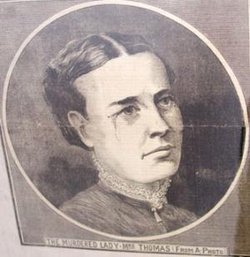
Julia Martha Thomas was a retired schoolteacher, twice widowed, aged about 54. Her doctor described her as “a small, well-dressed lady”. After the death of her second husband, in 1873, she lived alone at 2 Mayfield Cottages, in Richmond, on the outskirts of London: a two-storey grey stone cottage, with a garden at the front and one at the back, in an area that was then sparsely populated, close to a pub called The Hole in the Wall.
Although she was a small woman, Julia was known for her excitable temper and her neighbors considered her eccentric. She often traveled without telling anyone and without giving news to relatives or friends for weeks or months.
She was lower middle class and certainly not wealthy, but she liked to keep up appearances and always went out well dressed and wearing jewelry. And it was precisely to give an impression of prosperity that she wanted a live-in maid.
But she was a very harsh employer and her maids lasted very little time, leaving in exasperation.
On January 29, 1879, on the recommendation of a family of acquaintances, she hired Kate Webster. It was a fatal mistake.
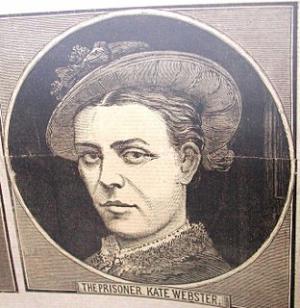
Kate Webster

Kate was born around 1849 in Killanne, County Wexford, Ireland, as Kate Lawler. The Daily Telegraph described her as a tall, strongly built woman of about 5 feet 5 inches, with freckled skin and large, prominent teeth. Little is known about her life, and much of what she said after her arrest proved to be false.
At about 15 she was arrested for theft in Ireland, and in 1867 she moved to England. The following year, in Liverpool, she was sentenced to four years of penal servitude, again for theft.
Out of prison, in 1873 she moved to London, where she befriended the Porter family. In 1874 her son John was born, but the father is unknown: Kate named three different men, and said of one that he was her accomplice and had forced her to steal.
During her years of thieving she often changed her name: Webb, Webster, Gibbs, Gibbons, Lawler. In 1875 she was arrested again and sentenced to eighteen months in prison, and shortly after her release to another year.
While in prison she left her son with Sarah Crease, a friend who worked as a maid in Richmond. When Sarah fell ill, Kate took her place, and it was the family she worked for who recommended her to Julia Martha Thomas.
Working as a maid
Julia hired Kate the same day, without asking too many questions about her past.
But after Kate moved into her house, their relationship quickly deteriorated.
Julia was unhappy with her work and criticized her constantly. Kate later said:
At first I thought she was a nice middle-aged lady… then I found her very trying; she would try to annoy me as much as possible while I was working. When I had finished a room, she would come in right after me and point out all the places she thought I hadn’t cleaned. This showed she didn’t like me.
Kate began to resent her. Julia noticed and no longer felt comfortable alone with her, so much so that she always invited friends over. In the end she decided to dismiss her, and the two agreed that Kate would leave the house on February 28. This is the last sentence found in her diary:
Gave Katherine warning to leave.
The murder
Kate persuaded Julia to keep her a few more days, until March 2. March 2 was a Sunday, the maids’ day off, but Kate was supposed to return in time to help Julia get ready for the evening church service.
Kate came back late, Julia scolded her and the two argued. But Julia had to go to church, and the argument would continue on her return.
When Julia came home, she confronted Kate. Here is what happened according to Kate’s confession:
Mrs Thomas came in and went upstairs. I went up after her, and we had an argument, which ripened into a quarrel. In the height of my anger and rage I threw her from the top of the stairs to the ground floor. She had a heavy fall. I became agitated, lost control of myself, and to prevent her screaming or getting me into trouble, I caught her by the throat and in the struggle she was choked.
Now Kate had to get rid of the body, and she decided to cut it up and boil it in the large copper used for laundry. Again, in her own words:
I determined to do away with the body as best I could. I chopped the head from the body with the assistance of a razor, then cut it up with a meat saw and a carving knife. I put the pieces in the copper and boiled them. I burned as much of the entrails as I could.
Julia’s remains
The neighbors noticed nothing and Kate went on living in the house as if nothing had happened. She washed the clothes and hung them out, just as she was supposed to.
Meanwhile she was getting rid of Julia’s remains, putting them in a box and a bag. She couldn’t fit the head and one foot: she threw the foot onto a dung heap, and buried the head, as would later be discovered, near the pub not far from the house.
Then, on the pretext of visiting acquaintances, she threw the remains into the Thames. The box was found by a fisherman, who opened it and discovered pieces of a corpse, but with the techniques of the time it was impossible to identify, and the remains were buried.
It is also said that Kate tried to sell the victim’s fat as dripping to neighbors and to the pub, but there was never any evidence: in all likelihood it is just a legend.
Kate went on living in Julia’s house and took on her identity, wearing her clothes. She even found a buyer for the furniture, a Hammersmith publican, John Church, who offered her £68.
On March 18, when the cart arrived to take the furniture away, the neighbors, who hadn’t seen Julia for two weeks, asked who had sold it. The removal men replied “Mrs Thomas”, and pointed at Kate.
Realizing she had been exposed, Kate fled. Police searched the house and found bloodstains, burned finger bones in the grate and fat behind the copper, as well as a letter with her address in Ireland. Kate had fled with her son to her uncle’s farm at Killanne, and was arrested there on March 29.
Kate Webster’s arrest and sentence
The trial began on July 2, 1879 at the Old Bailey and caused an enormous stir: the prosecution was led by the Solicitor General and the Crown Prince of Sweden even attended one of the hearings. Kate tried to blame Church and her former neighbor Porter, but both had alibis.
After six days the jury found her guilty. To avoid the death penalty Kate claimed to be pregnant, but a “jury of matrons”, twelve women chosen from the public, ruled that she was not.
On the evening of July 28 Kate confessed that she had acted alone. She was hanged on July 29, 1879 at Wandsworth Prison, and the crowd outside cheered when the black flag was raised. Julia’s house remained empty until 1897: nobody wanted to live there. Madame Tussaud’s even created a wax figure of the “Richmond Murderess”.
The incredible discovery

Naturalist David Attenborough had lived near Julia Thomas’s former cottage since the 1950s. The Hole in the Wall pub closed in 2007, and two years later Attenborough bought it to renovate it.
In October 2010, during the works, a skull was found. Analyses revealed it belonged to someone who died in the late nineteenth century, with a fracture consistent with a fall and very little collagen, a sign that it had been boiled.
In July 2011 the coroner officially declared that it was indeed the skull of Julia Martha Thomas. After 132 years, her head had finally been found.
🦋 Emadion lives through its readers. If this story kept you up at night, buy me a coffee: it helps me bring you the next nightmare.
☕ Support Emadion on Ko-fi