Posted by
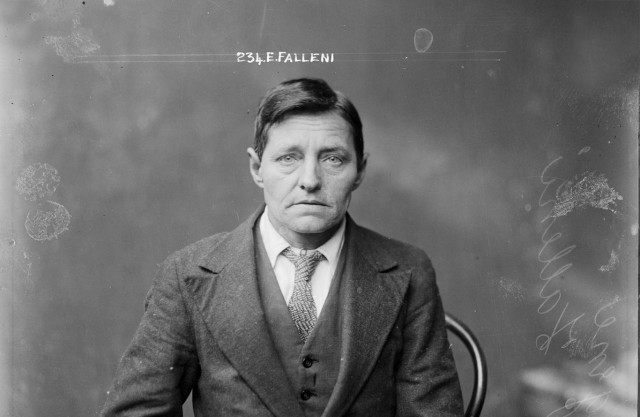
Eugene Falleni (1875-1938), born near Livorno and taken to New Zealand as a child, lived in Australia as a man under the name Harry Leo Crawford. In 1920 he was arrested for the death of his first wife, Annie Birkett, whose burned body had been found near Sydney in 1917. Sentenced to death on purely circumstantial evidence, he had his sentence commuted to life and was released in 1931. Today he is remembered as a transgender man.
Eugenia Falleni changed his name to Eugene, then to Harry Leo Crawford, and lived his life as a man. He was arrested for the murder of his wife, who according to the prosecution had discovered his sex at birth.
Note: in this article I use he/him, as today’s historical sources and his most complete biography do, describing him as a transgender man.
Eugene Falleni
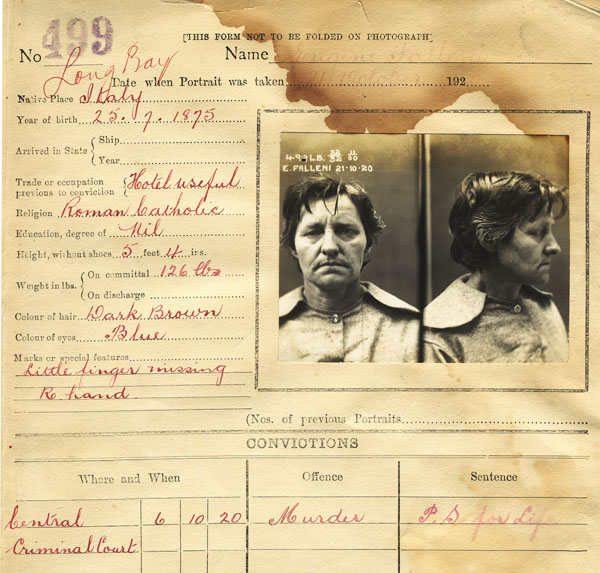
Eugenia Falleni was born on July 25, 1875 in Italy, near Livorno according to the family, or Florence according to others, and was the eldest of 22 children, 17 of whom survived childhood. Around 1877, when he was two, the family emigrated to Wellington, New Zealand.
His father, a stern disciplinarian, worked as a carrier and a fisherman. As a teenager Falleni began dressing as a man to find work in brickyards and stables. In September 1894 he married, but soon found out his husband was already married.
In 1895 he left New Zealand and began working on a ship, possibly as a cabin boy, under the name Eugene, the male form of his name.
His family made little effort to find him, as they had opposed his behavior for years.
Marriage in Australia
According to an unverified account that Falleni himself reportedly gave years later, after less than two years at sea the ship’s captain, a man named Martello, found out his sex at birth. Falleni gave himself away while drunk: speaking in Italian about his childhood, he said his grandmother often called him “piccolina”, little girl.
According to the same account, Falleni was ostracized by the rest of the crew and repeatedly raped by the captain. In 1898 he was put ashore, pregnant and penniless, at the next port, Newcastle, Australia.
In Sydney he gave birth to a daughter, Josephine Crawford Falleni, whom he entrusted to an Italian woman in Double Bay, Mrs. De Angelis. He immediately resumed his male identity, as Harry Leo Crawford, of supposed Scottish descent, and visited his daughter only rarely. Josephine grew up calling Mrs. De Angelis “Granny”, believing her father was a sea captain.
After various jobs in abattoirs, pubs and a rubber factory, in 1912 Falleni began working as a sulky driver and handyman for Dr. G. R. C. Clarke in Wahroonga, north of Sydney. There he met the housekeeper, Annie Birkett, a widow with a son named Harry.
Annie soon left the job to open a small confectionery shop in Balmain, and Falleni followed her, taking an interest in the business. On February 19, 1913 the two married and moved to Drummoyne, where Falleni worked in hotels and factories. Annie, it seems, knew nothing of his past.
Annie’s death
In 1917 a neighbor told Annie that her husband was actually a woman. Annie confronted him, but he denied everything, fearing she would go to the police.
On October 1 that year Annie suggested a picnic near the Lane Cove River. According to what Falleni later told the police, they argued because she wanted to leave him and, during the argument, Annie slipped backwards and hit her head on a rock.
Falleni said he tried to save her, but she died within minutes. In a panic, fearing an investigation that would reveal his identity, he tried to burn the body beyond recognition.
Second marriage
The body was found in scrubland in Chatswood. The medical examiner found “no definite marks of violence” and concluded she had died “probably due to burns”. The body was not identified and the police thought it was a suicide: a small bottle of kerosene had been found nearby and a woman “whose manner was strange” had been seen in the area. The inquest returned an open verdict and the remains were buried at Rookwood Cemetery as those of an “unknown woman”.
Falleni told his stepson Harry and the neighbors that Annie had run off with another man. In 1919 he met Elizabeth King Allison, known as Lizzie, who was over fifty, and married her that September, describing himself as a mechanical engineer born in Scotland.
The arrest
In 1920 Harry Birkett visited his aunt and told her things that made her suspicious. He said that after his mother’s disappearance Falleni had taken him to The Gap, a cliff in Sydney, trying to get him to come closer to the edge.
A week later, at night, he had taken him to scrubland in Double Bay and made him dig a hole. Then, distraught, he had thrown the shovel into the bushes and taken him back to the city.
Harry also remembered that his stepfather, who could not read, had asked him to read him an article about the unknown victim’s shoes. He went to the police and identified the woman’s belongings as his mother’s, especially the shoes, which Falleni himself had repaired.
Falleni was arrested at work on July 5, 1920 and asked to be placed in the women’s cells. He also asked that his wife Lizzie not be told about his past. Annie’s body was exhumed, but a second post-mortem revealed nothing new and the remains were returned to her family.
The trial
At the trial, held in October 1920 in Darlinghurst, the “man-woman” case caused a sensation: Falleni appeared first in a man’s suit, then in women’s clothes. Witnesses included the dentist who had made the false teeth found with the remains, Annie’s sister, who identified a gemstone found with the body, and her son Harry. A former landlady said Falleni had told her he had given his wife “a crack on the head”, and that one night he had spoken of wanting to kill the boy.
His daughter Josephine was treated as a hostile witness. She said she knew her mother lived as Harry Crawford and that, when Annie found out the truth, Falleni had seemed very agitated.
The prosecution also showed a wooden and rubber sex object found in Falleni’s home, as proof of how “practised in deceit” he was. But not all the evidence supported the prosecution: a man said he had seen a confused-looking woman with a suitcase near where the body was found, and some police officers had suggested the victim might have set herself on fire accidentally.
After only two hours the jury found Falleni guilty and the judge sentenced him to death. Falleni declared himself innocent, saying he had been convicted on false evidence. The appeal was dismissed, but the sentence was commuted to life imprisonment. The press portrayed him as a monster and a pervert, while many criticized the trial: there was no certainty the body was Annie’s and no concrete proof that he had killed her.
Freedom and death
After several petitions from friends and prison reform workers, in February 1931 Minister for Justice Joe Lamaro released him, as he was nearly sixty and in poor health.
He took the name Mrs. Jean Ford and became the owner of a boarding house in Paddington, Sydney. On June 9, 1938, just after selling it, he was hit by a car on Oxford Street and died the next day in hospital. He was identified only through his fingerprints and the £100 from the sale in his bag, and was buried under his last name at Rookwood Cemetery, the same cemetery where Annie had first been buried.
For decades the case was forgotten, until in 1988 writer Suzanne Falkiner published the biography Eugenia: A Man. Since then his story has been taken up by artists, playwrights, filmmakers and scholars, who tell it as that of a transgender man in early 20th-century Australia.
🦋 Emadion lives through its readers. If this story kept you up at night, buy me a coffee: it helps me bring you the next nightmare.
☕ Support Emadion on Ko-fi