
 Posted by
On August 30, 1970, in his home on Via Puccini in Rome, Marquis Camillo Casati Stampa di Soncino killed his wife Anna Fallarino and her young lover Massimo Minorenti, then took his own life. The investigation revealed that for years the marquis had pushed his wife to have sex with young men he chose and paid, while he watched and took photos. When Anna truly fell in love with one of them, the game ended in tragedy.
On August 30, 1970 Marquis Camillo Casati Stampa, his wife Anna and a friend were found dead, killed by gunshots. But who was responsible? The investigation would not only reveal that the killer was the marquis himself, who then took his own life, but that the couple’s married life hid a scandalous secret.
Biographical notes
Anna Fallarino was born on March 19, 1929 in Amorosi, in the province of Benevento. Her father was a clerk and her mother a housewife.
After the war she decided to escape poverty by moving to Rome. In those years working-class girls could dream of becoming film stars, and she dreamed of it too.
She is said to have had a small part in the film Tototarzan, but her career ended there. She then married engineer Giuseppe “Peppino” Drommi, owner of a small food company and a close friend of Marquis Casati Stampa, a wealthy man who introduced her to high society: he bought her designer clothes, furs and jewels, and that is how Anna began her social climb.
Camillo Casati Stampa di Soncino, born on January 8, 1927, was instead the heir of one of Milan’s oldest patrician families, owner of palaces and villas all over Lombardy. He too was married, to dancer Letizia Izzo, known as Lydia Holt, with whom he had a daughter, Anna Maria, born in Rome in 1951. Sources disagree on the year of the wedding (1949 or 1950); the couple lived in Rome, in Palazzo Barberini.
Camillo and Anna first met in Cannes in 1958 (some sources say 1955) and became lovers. According to several accounts, the spark came from an evening that went wrong: a playboy pestered Anna and Camillo stepped in to defend her, starting a brawl with overturned tables and shattered glass. Some sources identify that playboy as the famous Porfirio Rubirosa.
There was one problem, though: both were married, and divorce did not yet exist in Italy (it only became law in December 1970, a few months after their deaths). The only way out was the Roman Rota, the Church court that can declare a marriage null. A few months after the brawl Camillo started the process, and in January 1959 his marriage to Letizia Izzo was annulled. He gave his ex-wife a settlement of hundreds of millions of lire, a large house and maintenance for their daughter. For years it was rumoured that, to get the ruling so quickly, the marquis had spent around a billion lire in all, partly on “gifts” to influential clergymen: the rumour was never proven, but it circulated for a long time.
Anna also obtained an annulment of her marriage to Drommi from the Rota, and the two married in 1959. In his will, written in 1961, the marquis recalls marrying her in church on June 21 of that year.
The marquises’ scandalous secret
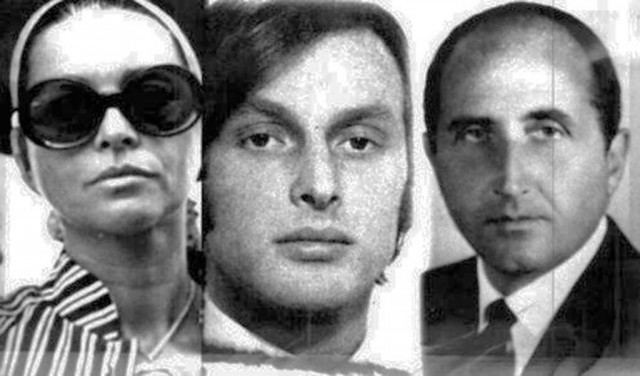
According to reconstructions, it was during their honeymoon that the marquis revealed his sexual tastes to his wife.
The marquis was a voyeur and paid good-looking young men, whom he personally chose, to have sex with his wife while he watched and took photographs.
It is said it all began on their very wedding night, when the marquis allegedly called a waiter to the room and had him sleep with his wife. The encounters were then recorded in great detail in a notebook covered in green satin, which would become famous as the “green diary”. There are also testimonies from some of the participants, such as a lifeguard. In one of the diary’s most quoted entries the marquis wrote: “Today Anna drove me mad with pleasure.”
The marquis personally chose the men: they were young, handsome and often from a low social class. Why this fantasy? At the time some psychologists tried to offer interpretations.
Perhaps the marquis was impotent and used the young men as substitutes, or perhaps he was attracted to men. Or perhaps, according to a psychoanalytic interpretation, he could not have sex with his wife because he identified her with his mother, and used other men to get around the taboo.
In any case Camillo Casati Stampa liked to be in control. He controlled his wife by choosing the men she would see and, according to accounts, had her undergo breast enlargement surgery to make her even more attractive.
Anna had accepted the game and apparently did not mind. Or was her desire for success and prestige so strong that she would have done anything to please her husband?
The favourite stage for this game was an island. In the 1960s the couple rented from the State the only building on Zannone, a small island in the Pontine archipelago near Ponza: a white villa on top of its highest hill. Every weekend yachts belonging to aristocrats, industrialists and millionaires moored there, and according to reports at the time the guests practised nudism and partner swapping. But the game went on in the city too: at the theatre, for example, the marquis would seat his wife in a miniskirt next to strangers and watch her from a box, urging her to provoke them. The photographs he took of her, collected in albums, reportedly numbered in the hundreds, according to some sources more than fifteen hundred.
The end of the game
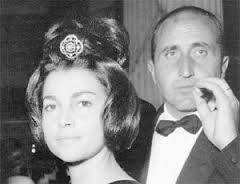
Their secret went on for years. Then Anna began organizing parties with many guests, and among them was often Massimo Minorenti, born in 1945, a long-term political science student already known in the society pages.
Massimo too had been paid by the marquis to have sex with Anna. But something went wrong: Anna and Massimo fell in love. This was not part of the game and one evening, among friends, the marquis burst out: “It is the first time my wife has betrayed me with her heart”.
Anna kept seeing Massimo, but the marquis was no longer the architect of their encounters, he no longer controlled the situation, he was no longer in charge. On July 7, 1970 he wrote in his diary that it was “the greatest disappointment” of his life, that he wished he were “dead and buried” and that he had thought they were “the only couple truly bound together”.
He thought about suicide and wrote to Anna asking her to visit him, once he was dead, at the family mausoleum in Muggiò cemetery. Then, however, he changed his mind.
The murder-suicide
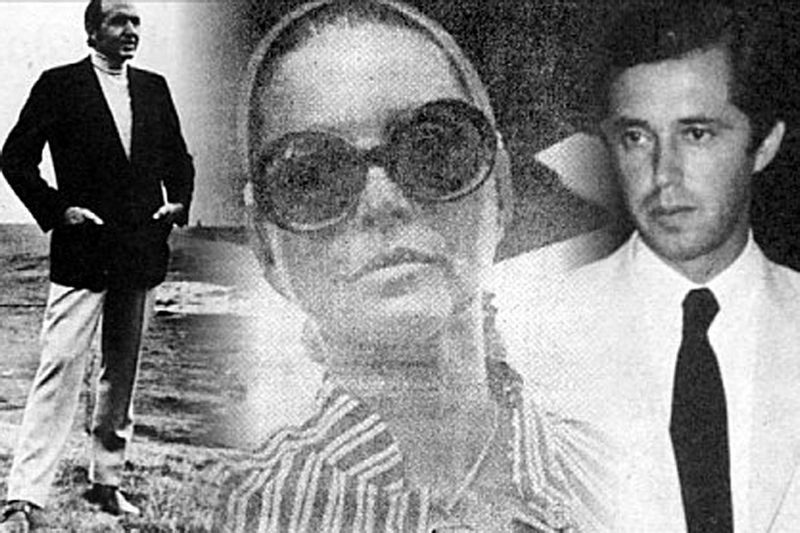
In late August the marquis took part in a hunt at the Marzotto family estate in Valdagno: according to reconstructions, he shot nearly two hundred ducks that weekend. At four in the morning on August 30, 1970 he phoned home in Rome, and Massimo Minorenti answered. For the marquis the betrayal was now obvious. He called back and this time Anna answered: he made serious threats and then rushed to Rome.
As soon as he arrived at the house at Via Giacomo Puccini 9 he told the five servants not to disturb him for any reason. On the back of an erotic calendar he wrote a last message: “My love, my life, forgive me, but what I am about to do I must do. Goodbye, my only past joy”.
Then he took a 12-gauge Browning shotgun and went into the living room, where Anna and Massimo were waiting for him. He fired three shots at his wife and two at Massimo, who had grabbed a small table in a desperate attempt to shield himself. He used the last shot to take his own life.
The servants, hearing the shots, called the police without entering the room. Officer Domenico Scali later said that the first person he saw was Anna, sitting on the sofa with her legs crossed on a stool, her hands in her lap and a serene face, so much so that she seemed still alive. The only jarring note was a bloodstain on her blouse. Next to her was Massimo, curled up on the floor behind the little table. According to the autopsy, Anna died instantly, at the first shot.
The scandal
At first a robbery gone wrong was suspected, or that Minorenti had killed the couple. But the truth soon came out, thanks partly to the green diary and the interrogations. In the following days some newspapers published photos of the marchioness naked, in provocative poses, and the affair became one of the greatest scandals in Italian crime history. It was also said that some of those pictures reached journalists through members of the police, and for weeks the papers competed to publish photos and pages from the diary.
According to the magistrates’ report, the marquis had come to view his relationship with his wife in a way that allowed him to tolerate her occasional lovers and, above all, to be aroused by and fully enjoy her participation.
The marquis was buried, as he had asked, next to Anna in the family mausoleum in Muggiò. His fortune was estimated at more than 2.4 billion lire. In his will he had left almost everything to his wife, but since she died before him, the inheritance went to his daughter Anna Maria, then nineteen. The Fallarino family contested it, assisted by lawyer Cesare Previti, who then went on to represent Anna Maria herself. Among the Casati properties was also Villa San Martino in Arcore which, since 1974, has belonged to the Berlusconi family.
After the crime
What the newspapers of the time called “a drama of jealousy”, many today would call by another name: femicide. Anna was not just the star of a sex scandal, but the victim of a man who had made decisions for her for years, right up to the last shot.
The case, however, has never stopped fascinating people. The marquis’s daughter, Anna Maria, years later even wrote a book on parapsychology about the ghosts that, she claimed, haunt the family villa in Arcore. In Rome some tours of crime scenes take visitors to the building on Via Puccini, and in 2020 the writer Maria Pia Selvaggio devoted the book Il delitto di via Puccini to the case.
🦋 Emadion lives through its readers. If this story kept you up at night, buy me a coffee: it helps me bring you the next nightmare.
☕ Support Emadion on Ko-fiSources
- Delitto Casati Stampa – Wikipedia (Italian)
- Casati Stampa murders – Wikipedia
- Il caso Casati Stampa: cronistoria – Rete L’Abuso (Italian)
- Delitto Casati Stampa: non fu un dramma della gelosia – Donna Moderna (Italian)
- Il delitto Casati Stampa – Leccenews24 (Italian)
- Casati Stampa: delitto e retroscena – UAU Magazine (Italian)
- Il delitto Casati Stampa – L’Undici (Italian)
- Zannone – La Patilla (Spanish)
- Il diario verde – Notizie.it (Italian)
- Arcore, la villa dei misteri – L’Espresso (Italian)

Very interesting but sad story. He should’ve just killed himself. He opened that door to his wife finding someone else by using her as some prized sex doll that anyone could have. Too bad. Open relationships don’t tend to end very well. When you sacrifice what should be intimacy shared by two people so that you can live out a fantasy, it invariably goes wrong. RIP Anna and Massimo. Rot in hell, Camillo.
Very interesting but sad story. He should’ve just killed himself. He opened that door to his wife finding someone else by using her as some prized sex doll that anyone could have. Too bad. Open relationships don’t tend to end very well. When you sacrifice what should be intimacy shared by two people so that you can live out a fantasy, it invariably goes wrong. RIP Anna and Massimo. Rot in hell, Camillo.
I wonder how many open relationships you have enjoyed Chris? I have enjoyed Massimo’s role with married women over time, and none have ended like this. Fun was enjoyed, and people went their separate ways. As with ALL human tragedies, it is the EGO that causes the trouble. This Marquis obviously had a colossal, uncontrolled ego that couldn’t be restrained when his wife acted outside of his wishes. The outrageous hussy. C’est la vie.
I haven’t had any open relationships.