 Posted by
Human zoos were exhibitions in which people from other cultures, mostly Africans, Asians and Native Americans, were shown to the public in enclosures and reconstructed villages, often next to animals. They spread across Europe and the United States from the 1870s, during colonial expansion, and the last major example was the Congolese village at the 1958 Brussels World’s Fair. Among the best-known people put on display are Ota Benga and Sarah Baartman.
In the 21st century many people consider zoos extremely cruel. Taking wild animals out of their habitat and displaying them in cages and enclosures for people’s entertainment seems truly merciless. What not everyone knows is that throughout history there have been not only animal zoos, but also human zoos.
Human zoos in history
One of the first known zoos was that of the Aztec emperor Montezuma, in Mexico, in the early 16th century.
It displayed not only a large collection of animals, but also dwarfs, albinos and hunchbacks.
Christopher Columbus, too, on returning from his first voyage, brought some Native Americans to Europe to show them to the Spanish court. During the Renaissance the Medici family kept large menageries in Italy, and in the 16th century Cardinal Ippolito de’ Medici reportedly kept people of different peoples alongside exotic animals, described as “savages”, Moors, Tartars, Indians, Turks and Africans.
Human zoos in the modern age

It was in the 1870s, in the era of New Imperialism, that human zoos became really popular. Individual people displayed as curiosities gave way to large “ethnological” exhibitions featuring entire groups and communities.
One of the leading promoters of this new kind of show was German animal trader Carl Hagenbeck, who in 1874 organized an exhibition of Sámi people recreating what was presented as their natural environment, with animals, plants and huts. Exhibitions like this were held in many European and American cities and were hugely successful, often drawing hundreds of thousands of visitors.
At the 1889 Paris World’s Fair, visited by 28 million people, about 400 Indigenous people were displayed in a “Negro Village”, one of the fair’s most popular attractions. Sometimes they were made to wear traditional clothing, other times they were left almost naked.
Similar exhibits were held in Amsterdam, Chicago, Brussels and Buffalo. At the 1904 St. Louis Exposition more than 1,100 Filipinos were exhibited. The stated aim was to show the variety of the world’s peoples, but in reality these shows presented colonized peoples as “primitive”, sometimes classifying them as past stages of human evolution, and thus served to justify colonialism.
Ota Benga
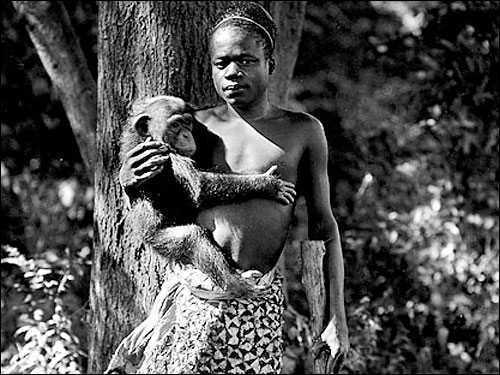
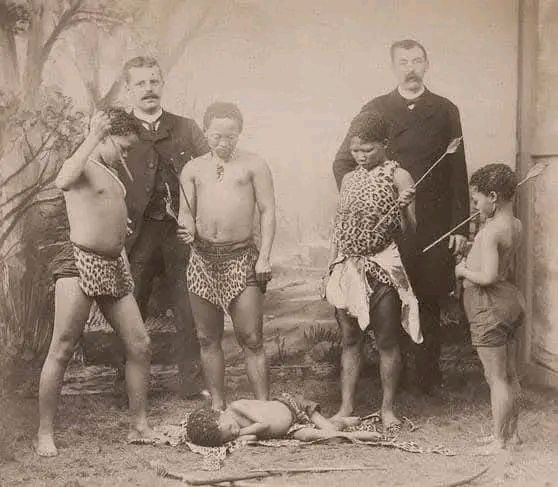
One of the most famous people exhibited in a human zoo is Ota Benga, a Mbuti pygmy from the Congo who in 1906 was put on display in the Monkey House at the Bronx Zoo, New York, in the same cage as an orangutan.
Ota was born around 1883 near the Kasai River, in King Leopold II of Belgium’s Congo Free State. His people were attacked by the Force Publique, the Belgian colonial militia: his wife and two children were slaughtered and he survived only because he was out hunting. He was then captured by slave traders, who sold him to American Samuel Phillips Verner, who was in Africa looking for pygmies to exhibit at the 1904 St. Louis Exposition.
Verner bought him for a pound of salt and a bolt of cloth. He later claimed he had rescued him from cannibals.
A bond grew between the two and, after the St. Louis fair, Ota briefly went back to Africa with Verner, but decided to return to the United States. At the Bronx Zoo, to make him look more “savage”, he was given a bow and arrows, which he used to shoot at visitors who mocked him. African-American newspapers and a delegation of Black churches protested strongly, and at the end of 1906 the mayor released him to an orphanage in Brooklyn.
In 1910 Ota moved to Lynchburg, Virginia, where he learned English and worked in a tobacco factory. He wanted to go back to Africa, but the outbreak of World War I halted passenger ships. He fell into depression and in 1916 took his own life.
Sarah Baartman
Another protagonist of these shows was Sarah Baartman, also called Saartjie and known as the “Hottentot Venus”, a name invented by those who exhibited her. “Hottentot” was the colonial term for the Khoikhoi people, and is now considered offensive.
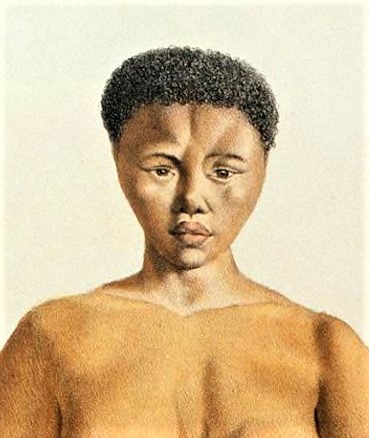
Sarah was a Khoikhoi woman born around 1789 near the Gamtoos River, in present-day South Africa. She had steatopygia, a strong accumulation of fat on the buttocks, typical of some peoples of southern Africa, which in Europe was seen as a curiosity.
From 1810 she was exhibited in London, almost naked, to show off her body, and in 1814 she was taken to Paris and sold to an animal trainer. There she attracted the attention of scientists, including naturalist Georges Cuvier, who had her examined in 1815. Sarah died shortly after, probably aged 26.
Cuvier made a plaster cast of her body, kept her skeleton and preserved her brain and genitals in jars. Her remains were displayed at the Musée de l’Homme in Paris until 1974.
After the end of apartheid Nelson Mandela formally asked France to return them. In 2002 Sarah Baartman’s remains finally went back to South Africa and were buried in her homeland, the Gamtoos River valley, in Hankey. Her grave is now a national heritage site.
The end of human zoos
In the first half of the 20th century more and more people became outraged by these shows and human zoos slowly disappeared. But not right away.
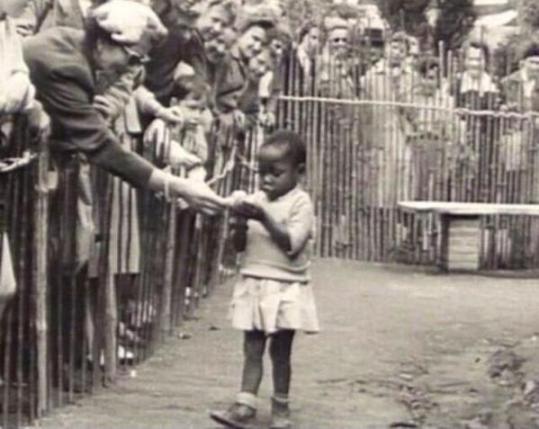
At the 1958 Brussels World’s Fair a Congolese village was still set up, with 598 people, including 197 children. In mid-July the Congolese protested against the condescending treatment and demanded to be sent home, abruptly ending the exhibit.
An eight-month-old baby, Juste Bonaventure Langa, also died during that Expo; he rests in the Tervuren cemetery. It is considered the last great human zoo in history.
🦋 Emadion lives through its readers. If this story kept you up at night, buy me a coffee: it helps me bring you the next nightmare.
☕ Support Emadion on Ko-fi