 Posted by
Can you use mathematics to find serial killers? It seems so, and there is an equation that can track down serial killers, invented by Canadian criminologist Kim Rossmo. The technique is called “geographic profiling” and grew out of research at the School of Criminology at Simon Fraser University, Canada, in 1989.
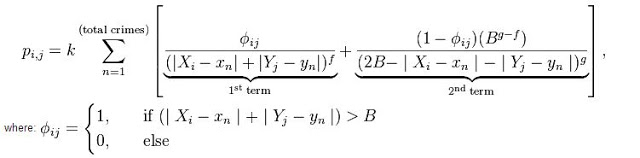
Rossmo developed an equation by which, using the geographic data of the crimes already committed, it is possible to trace the area of residence of the criminal. How is that possible?
The equation takes into account several factors, including the habit of a killer or a criminal to act not too far from his or her home but also far enough away to avoid being connected to the crimes committed.
Criminologists speak of “distance decay”: the further a place is from home, the less likely the offender is to strike there, because everyone tends to act in areas they know well, such as around home, work or school. Around the home, however, there is a “buffer zone” where the offender avoids striking for fear of being recognised by neighbours. Over time, as confidence grows, the crimes tend to move further and further away.
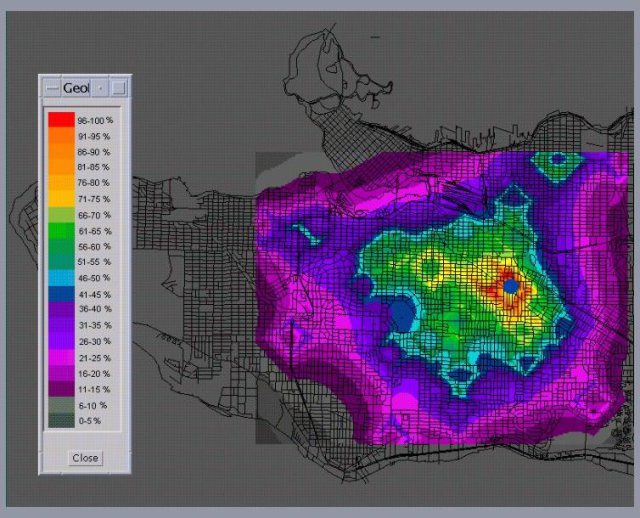
Putting all the data in a computer and using the equation, the geographical map is divided into different colored areas and each colour corresponds to a much higher degree of probability that the criminal actually resides there.
In the picture above you can see an example: the red areas are those with the highest probability of being the resident area of the criminal.
Once you find the most probable areas a cross check is done by the police, in which the non-geographical data of the criminal are considered, such as sex and age, and a more detailed check is carried out.
This equation, although it was not taken seriously when it was first proposed by Rossmo, was instrumental in the capture of a serial rapist in Lafayette, who ended up being a deputy sheriff in the area.
Despite this success, however, this equation does not work so well in all cases because of the many variables involved, but it is always being improved.
The first episode of the show “Numb3rs” takes its cue from this equation, as shown here below.
Who Kim Rossmo is
Kim Rossmo was born in 1955 and joined the Vancouver Police Department in 1978, first as a civilian and then, from 1980, as an officer. In 1995 he became the first police officer in Canada to earn a doctorate in criminology, and his formula came out of his dissertation; it was later turned into crime analysis software called Rigel.
In 1998, analysing the disappearance of many sex workers in Vancouver, Rossmo concluded that a serial killer was at work. His superiors did not believe him and in 2001 he left the force after a dispute with senior officers. The following year Robert Pickton, one of Canada’s worst serial killers, was arrested: according to a retired staff sergeant, hostility towards Rossmo may have delayed the arrest, leaving Pickton free to kill again.
Today Rossmo teaches criminology at Texas State University, where he directs a centre for geospatial intelligence, and applies geographic profiling to counterterrorism, epidemiology and even the study of how animals forage and how invasive species spread.
🦋 Emadion lives through its readers. If this story kept you up at night, buy me a coffee: it helps me bring you the next nightmare.
☕ Support Emadion on Ko-fi