 Posted by
Sleep paralysis is a state in which, while waking up or falling asleep, you are conscious but completely paralysed, sometimes with hallucinations. It happens when the muscle paralysis of REM sleep carries on after you wake. Between 8% and 50% of people experience it at least once. I have had it since I was a child, and here I tell you what it is like.
Sleep paralysis is a sleep disorder in which the sufferer wakes up completely paralysed.
“I am sleeping, but I hear a noise and wake up. I open my eyes, I want to sit up but I can’t. I instinctively try to lift my head, but every muscle is paralysed. I try to move my arms, my legs, I try to speak, to call someone, but no sound comes out of my mouth. Now I struggle even to keep my eyes open, I make a huge effort and my eyelids seem to tremble, letting me see little or nothing of the room. I know that if I relaxed it would all pass in a few seconds, but my instinct tells me to try to move. Trying to move your muscles when they are paralysed is not only exhausting, it leaves you feeling helpless and frustrated. And even if it has happened before, sometimes anxiety still catches you off guard and makes you think: This time it’s for real. I’ll stay like this forever. Then finally I close my eyes and relax. A few seconds and I sit bolt upright, gasping for air, like coming up to the surface after holding your breath for a long time.”
Sleep paralysis
This disorder, also called hypnagogic paralysis, is a sleep disorder like sleepwalking. While sleepwalkers walk or do things in their sleep, people with sleep paralysis are completely paralysed at the moment of waking up, or sometimes just before falling asleep. Since I suffer from it, I can give you a detailed description.
It usually happens on waking. The person wakes up and manages to open their eyes a little, but cannot move. Every muscle is completely paralysed and it is impossible to move any part of the body, even slightly, or to speak. It is like being nailed to the bed.
Sleep paralysis can cause anxiety and panic while it is happening, because it leaves you feeling helpless. It usually passes in less than a minute, and relaxing can help you come out of it.
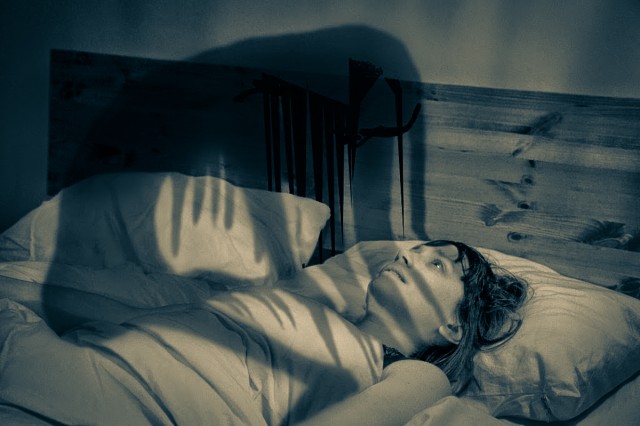
During the paralysis you may also see shadows or dark figures on your chest or in the room. These are hypnagogic hallucinations.
Why sleep paralysis happens
When we sleep and enter the REM phase, a mechanism kicks in that paralyses our muscles so we do not act out in reality the movements we make in our dreams. In sleepwalkers this mechanism is missing, which is why they do things in their sleep. In people with sleep paralysis, instead, the mechanism stays active even after waking. At that moment the mind is awake and conscious, but the body is still “asleep”.
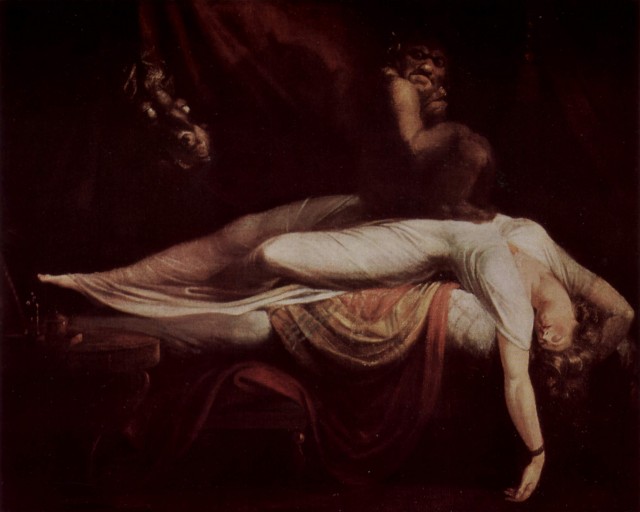
Although it is a disorder people have only recently started talking about, it has actually been known since ancient times all over the world. In the past people thought the paralysis was caused by spirits sitting on the victim’s chest. This theory was perhaps also used to explain the strange figures seen during the paralysis.
But how common is it? More than you might think: depending on the study, between 8% and 50% of people have had at least one episode in their lives, and about 5% have it regularly. It affects men and women equally. It can happen to perfectly healthy people but also to people with narcolepsy, and sometimes it seems to run in families. It can be triggered by lack of sleep, stress and irregular sleep schedules.
Besides dark figures, during episodes some people hear noises such as humming, hissing or voices, some feel a weight on their chest and the sensation of being unable to breathe, and some feel dragged out of bed or floating. According to some researchers, sleep paralysis may have helped create many stories of night demons, ghosts and even alien abductions.
Witches, demons and ghosts: sleep paralysis in folklore
Almost every culture has given a face to the presence that sits on your chest. The painting you see above is The Nightmare (1781) by Henry Fuseli (Johann Heinrich Füssli), with a little demon crouching on the chest of a sleeping woman: according to some accounts, the painter was inspired by the sensations of sleep paralysis.
In Italy the best-known creature is the Pandafeche (or Pantafica), typical above all of Abruzzo, Marche and Umbria: a witch, sometimes a spirit or a cat-like being, that climbs onto the chest of a sleeper. According to tradition, to keep her away you had to leave a bag of sand or beans by the bed, because the witch would stop to count the grains. It is not just an old legend: in a 2015 study by the universities of Padua, California and Harvard, 38% of the people examined who had had at least one episode thought it could be caused by this creature, and 28% were certain of it. The same study noted that people who give the paralysis a supernatural explanation tend to have more episodes.
In Newfoundland, Canada, people speak of the Old Hag, who sits on sleepers; in Japan the phenomenon is called kanashibari, “metal binding”, as if you were held down by chains. In Brazil there is the Pisadeira, a long-nailed creature that prowls rooftops at night and tramples on the chests of sleepers, while in Catalonia the Pesanta is a black animal, often a dog or a cat, that sits on your chest and takes your breath away. Among Cambodians there is “the ghost that pushes you down”, and in Egypt the jinn are blamed.
My personal experience
I have suffered from it since I was a child. I think I had my first paralysis at about 10, I was scared but did not give it too much thought. Obviously it does not happen every night: it comes in phases, and many months can go by without an episode. But I can also have several episodes in a week.
When I wake up and find myself paralysed I usually try to relax, close my eyes and it all passes. Sometimes, though, I try to move at all costs, maybe because I have just had a nightmare, making the situation worse and longer. Once I tried to call my partner, who was sleeping next to me, but no sound came out of my mouth.
I do not have hallucinations during the paralysis, but I sometimes have them if I wake up at night or just before waking up. I do not see black or hooded figures, just black shapes, like threads hanging from the ceiling. Another common hallucination for me is insects, which I see crawling on the walls. Every time I try to grab these hallucinations, thinking they are real, and every time I realise they do not exist.
It is funny, because every time I tell myself “ok, next time I won’t fall for it” and instead, without fail, I reach out to grab the threads hanging from the ceiling. Rarely have I seen other things. I remember seeing a little girl for several nights in a row, and a broken mirror.
Both the hallucinations and the paralysis, at least in my case, do not only happen at night but at any time of day. I have fallen asleep in the afternoon and woken up paralysed.
Are sleep paralysis episodes scary?
By now I am not scared any more, I am used to it, and when I have an episode like this I relax and wake up normally. If it has not happened for a long time, or if I am nervous or frightened, I cannot relax and I try to move at all costs, in vain.
I may be frightened by a nightmare I have just had or, much more often, because I hear noises. I do not know if they are real or auditory hallucinations, but they always make me very anxious, because I think there is danger and I want to get up at all costs, only making things worse and prolonging the paralysis.
Sometimes, after recovering and falling back asleep, I wake up shortly afterwards with another paralysis. The paralysis always happens on waking, but on a few rare occasions it has happened while I was falling asleep. I have noticed that when it happens I am always lying on my back, even though I usually sleep on my side.
How do you deal with it?
To date there is no drug that can eliminate this disorder completely, and treatments have been little studied. The first step is usually knowing that it is a common phenomenon and generally not dangerous. Keeping regular sleep hours and getting enough sleep helps you have fewer episodes. There is also a specific cognitive behavioural therapy that teaches relaxation techniques and how not to panic during an episode. In more serious cases doctors may prescribe certain antidepressants and, if episodes are very frequent, it is a good idea to get checked to rule out narcolepsy.
Some people say this peculiar state can be used to have lucid dreams, dreams in which we are aware and can steer as we like. Others claim that sleep paralysis allows astral travel. I have never experienced either, but who knows, you never can tell!
And you, have you ever had sleep paralysis?
🦋 Emadion lives through its readers. If this story kept you up at night, buy me a coffee: it helps me bring you the next nightmare.
☕ Support Emadion on Ko-fiSources
- Sleep paralysis, Wikipedia
- Focus – Misteriose paralisi del sonno, per il 38% delle vittime è colpa di una bestia fantasma
- Live Science – The Demon on Your Chest and Other Terrifying Tales of Sleep Paralysis
- Culture, Medicine, and Psychiatry – Study on sleep paralysis and the Pandafeche in Italy (2015)