
 Posted by
In short
- Where: Loch Ness, Scottish Highlands, a lake about 37 km long and more than 220 metres deep.
- First mention: Adomnán’s Life of Columba, 7th century, which tells of a “water beast” in the River Ness.
- Birth of the modern myth: 1933, with the sightings reported by the Inverness Courier.
- The most famous photo: the 1934 “surgeon’s photograph”, exposed as a hoax in the 1990s.
- Today: a 2018 environmental DNA study found no trace of reptiles, but a huge amount of eel DNA.
The Loch Ness Monster, also known by the nickname Nessie, is one of the most famous monsters of the modern age.
The first sighting of the Loch Ness Monster
Its most famous photo was taken in 1934, right after the first modern sightings, but not everyone knows that the first account of a monster near Loch Ness dates back to 565 AD.
Adomnán of Iona, abbot of the monastery founded by Saint Columba, in his “Life of Columba”, written about a century after the events, described the funeral of a man attacked by a “water beast” while swimming in the River Ness, which flows out of the loch. According to the account the creature had bitten him and dragged him under, despite the locals’ attempts to rescue him by boat.
He then tells how Saint Columba sent one of his companions, Luigne moccu Min, to swim across the river. The beast attacked him, but the Saint made the sign of the cross and ordered it to go away, and the creature fled in terror. More than a chronicle, it is a hagiographic tale meant to show the Saint’s power over the forces of nature, but it is still the starting point of the whole legend.
Later accounts date to the 1930s, although there were a few rare ones before. One of the most quoted goes back to 1871, when Dr Mackenzie of Balnain saw something moving in the loch. He wrote about it in a letter to a friend only in 1934, when interest in Nessie had grown exponentially.
The first modern sighting
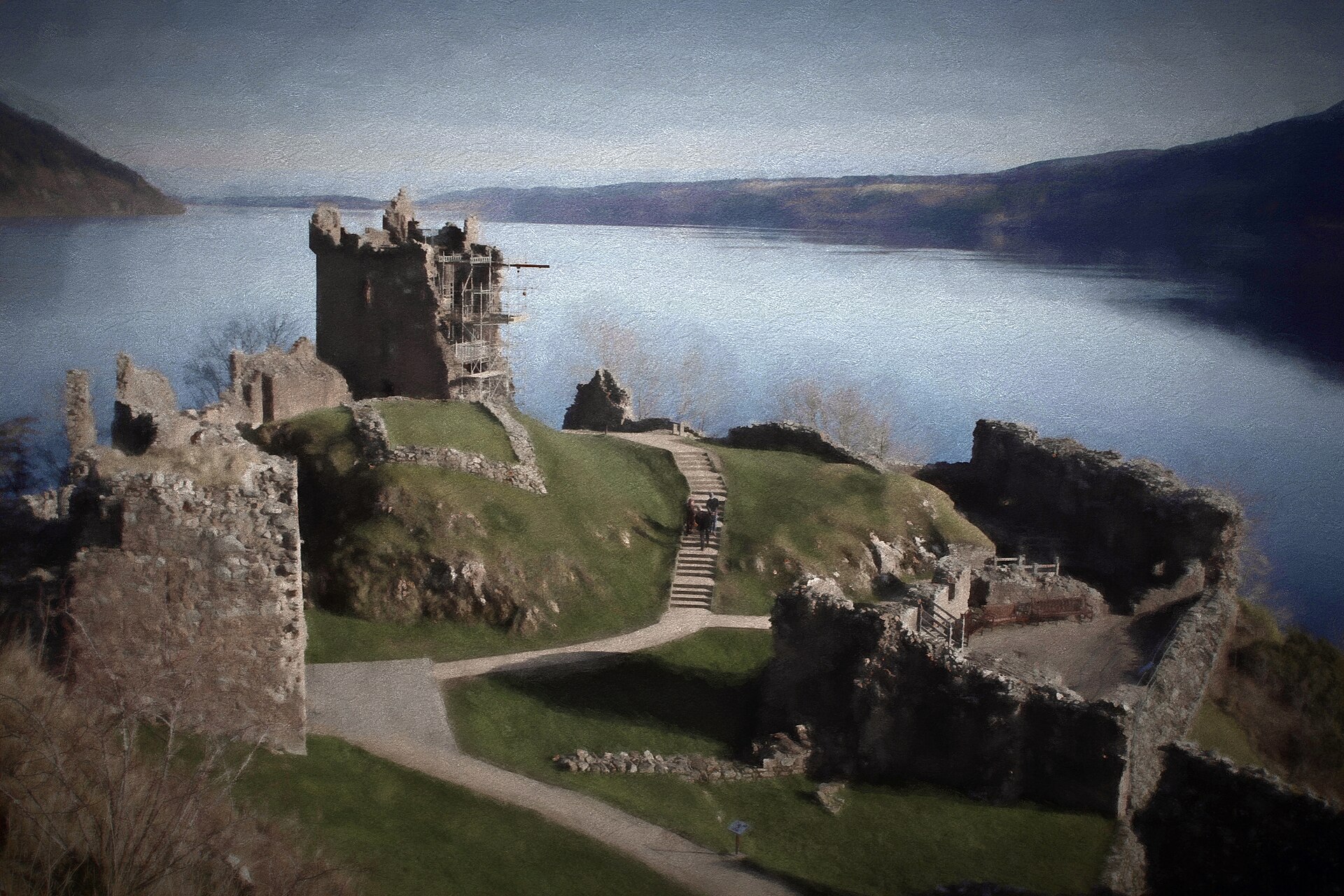
The modern myth was born on 2 May 1933, when the Inverness Courier published an article by Alex Campbell, the loch’s water bailiff and a part-time journalist, about Aldie Mackay’s sighting of a whale-like “beast” churning the water. That same year the road along the north shore of the loch had just been completed, giving thousands of drivers a clear view of the water for the first time.
Shortly after, in July 1933, George Spicer and his wife said they saw the shape of an enormous animal cross the road in front of their car, about 1.2 metres tall and 7.6 metres long, with a long thin neck, before it disappeared towards the loch.
On 5 January 1934 motorcyclist Arthur Grant claimed he nearly hit a creature at about 1 a.m. while approaching Abriachan, on the north-eastern shore of the loch. Right after, the beast went back into hiding in the water. Grant, a veterinary student, described it as a cross between a seal and a plesiosaur.
Another sighting came in 1943 from C. B. Farrel of the Royal Observer Corps, who said he saw a creature about 6 metres long with a neck of around 1.2 metres.
Then we move to 1954, when the fishing boat Rival III recorded a strange sonar contact showing a large object travelling at about the same speed as the boat at a depth of 146 metres.
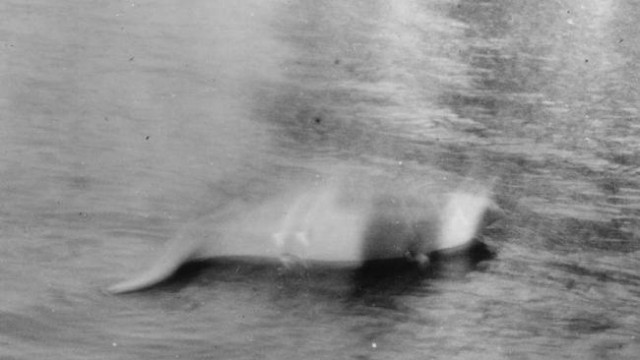
The first alleged photo of Nessie dates to November 1933, but it is not the most famous. It was taken by Hugh Gray while walking along the shore near Foyers: suddenly he saw something emerge from the water and took a few pictures, many too blurred to show anything, except one that seems to show an animal’s body coming out of the water.
The photo, which you can see above, is blurred, and some studies have suggested it could be the man’s dog swimming towards the shore with a stick in its mouth.
The iconic photo of Nessie
A few months later the monster’s most famous photo was taken, the one showing the silhouette of a long neck rising from the loch, published on 21 April 1934 in the Daily Mail.
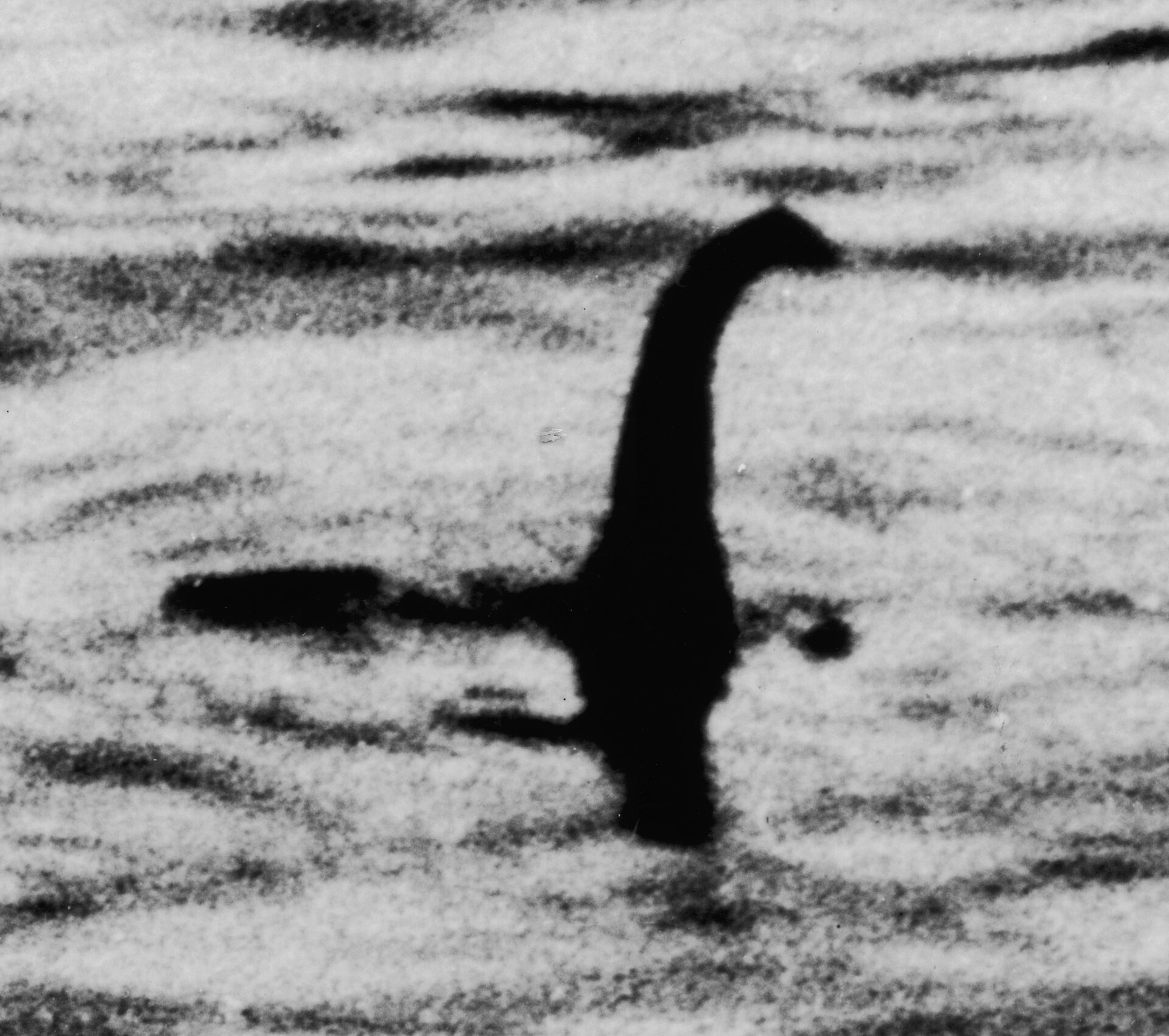
The photo was credited to London gynaecologist Robert Kenneth Wilson but, since the doctor did not want his name associated with it, it became famous as “the surgeon’s photograph”.
For sixty years it was believed to be genuine, until the truth came out: in 1993 Christian Spurling, then ninety and shortly before his death, confessed to researchers David Martin and Alastair Boyd that the picture showed a toy submarine he had built, fitted with a neck sculpted from plastic wood, with the help of Ian Wetherell and insurance agent Maurice Chambers. The confession was made public in 1994 and later told in the two researchers’ 1999 book.
The model was placed in the loch and the photos were taken. The plates were then handed to Wilson, a respectable man above suspicion, who had them developed and sold them to the Daily Mail.
It all started as revenge: in December 1933 Ian’s father, Marmaduke Wetherell, a film director and big-game hunter, had been hired by the Daily Mail itself to find the monster, and announced he had found its footprints. The prints, however, turned out to have been made with an umbrella stand made from a hippo’s foot, and the paper held him up to ridicule. Spurling was his stepson.
After being mocked, Wetherell decided to set the whole thing up, and for decades his prank was the most quoted “proof” of Nessie’s existence.
The Loch Ness Monster on film
In 1955 another photo was taken, this time by P. A. MacNab, who was photographing Urquhart Castle. Instead of the neck, this picture would show the animal’s body, with two dark humps on the water.
There are not only photos but also film footage from 1938, shot by G. E. Taylor: about three minutes on 16 mm colour film. The film ended up with science writer Maurice Burton, who never showed it to other researchers and published a single frame in his 1961 book.
Cryptozoologists considered it clear evidence of the monster’s existence, while other scholars are not convinced.
Another film dates to April 1960 and was shot by Tim Dinsdale, an aeronautical engineer, who filmed a hump moving across the water and leaving a wake. In 1966 the RAF’s photographic interpretation centre analysed it and concluded the object was probably animate. Many remained sceptical, others thought it was further evidence that the monster really existed.
In 1993 the documentary “Loch Ness Discovered” enhanced the footage, revealing what seems to be the outline of a body beneath the hump. A computer expert who worked on it said he had always thought the monster was nonsense, but was no longer so sure after seeing the new footage. Other analysts, however, argued it was simply a boat.
In 2011 Marcus Atkinson, while boating on the loch, captured on sonar something that followed his boat for about two minutes. While he is convinced it was the monster, others think it was a shoal of fish or algae.
The most recent research
In 2018 an international team led by geneticist Neil Gemmell of the University of Otago collected hundreds of water samples at different depths, analysing the environmental DNA left by every organism in the loch. The results, presented in 2019, found no reptile sequences at all: according to Gemmell we can be fairly sure there is no giant scaly reptile swimming in the loch.
They did, however, find a huge amount of eel DNA. Gemmell did not rule out eels of exceptional size, although none has ever been caught, while the other explanation is that the DNA simply comes from a great many small eels.
In August 2023, for the 90th anniversary of Aldie Mackay’s sighting, Loch Ness Exploration volunteers and the loch’s visitor centre organised the largest search in decades, with infrared drones and hydrophones lowered into the water. A few suspicious sounds were recorded, but no proof of the monster.
Hypotheses
To this day no firm conclusion has been reached: sceptics say that if the monster really existed in the 6th century, it would be dead by now, yet no bones or animal remains have ever been found.
If it were a single monster it would certainly be extinct, while if it were a population of several animals, as would be needed to survive for centuries, we should have more concrete evidence of their existence, and we don’t. There is also a geological problem: the loch formed after the last ice age, about 10,000 years ago, while plesiosaurs, to which Nessie is often compared, went extinct 66 million years ago.
Moreover, according to them, Loch Ness would not have enough food to feed such an animal.
Supporters of the monster’s existence, on the other hand, claim there are underground channels linking the loch to the sea, which could supply Nessie’s food. Nothing underground has ever been found, but the loch really is connected to the sea, through the River Ness and the Caledonian Canal. They also suggest the monster could find food on land.
And you, what do you think?
🦋 Emadion lives through its readers. If this story kept you up at night, buy me a coffee: it helps me bring you the next nightmare.
☕ Support Emadion on Ko-fiSources
- Wikipedia, Loch Ness Monster
- Wikipedia, Life of Columba
- Wikipedia, Tim Dinsdale
- Wikipedia, Caledonian Canal
