 Posted by
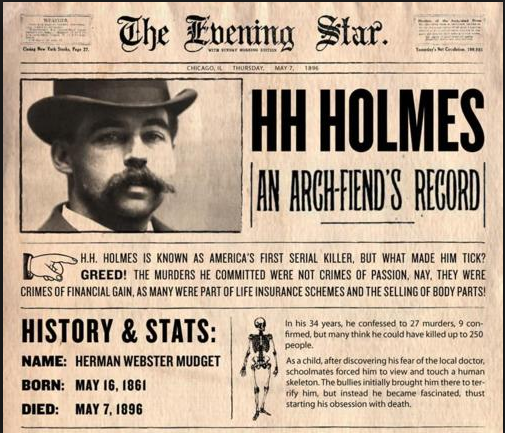
Herman Webster Mudgett, known as H. H. Holmes (1861-1896), was a con artist and murderer active in Chicago around the time of the 1893 World’s Fair. He was hanged on 7 May 1896 for the murder of his accomplice Benjamin Pitezel. He confessed to 27 murders, but some of the people he claimed to have killed were still alive. Many legends about his “murder castle” come from the sensationalist press.
H. H. Holmes was one of the first documented serial killers in the United States. He is famous for building a hotel (called the “castle” because of its size) and using it to lure his victims. Legends speak of more than 200 victims, although the murders actually proven are far fewer.
H. H. Holmes
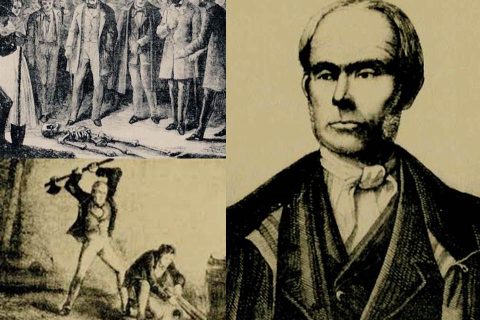
Holmes was born in 1861 as Herman Webster Mudgett, but he is better known as Dr Henry Howard Holmes. He grew up in a farming family with a violent, alcoholic father. He got excellent grades at school and for this reason was often picked on by classmates jealous of his abilities. Once they dragged him into the science classroom and stood him in front of the skeleton used in lessons, even placing its bony hands on his face. At first Holmes was terrified, but then he became fascinated by the skeleton, and from that moment on he began dissecting animals.
At 16 he finished high school and at 17 he married Clara Lovering, who gave him a son. At 21 he enrolled in medical school and graduated in 1884 from the University of Michigan, though with mediocre results. While at university he stole corpses from the laboratory. He took out a life insurance policy on each of the dead, then disfigured the bodies, claimed they had died in accidents and collected the insurance money.
His marriage failed and he abandoned both his wife and their son. He worked odd jobs for a while and kept up his scams. When it emerged that he had been the last person to see a little boy who had mysteriously disappeared, he moved to Philadelphia. There too he was linked to the death of a boy, so he moved to Minnesota, where he married Myrta Belknap without divorcing his first wife. He lived with his wife and daughter in Illinois, but spent a lot of time on his business in Chicago. In 1894 he married Georgiana Yoke while still married to both Clara and Myrta.
H. H. Holmes’s castle
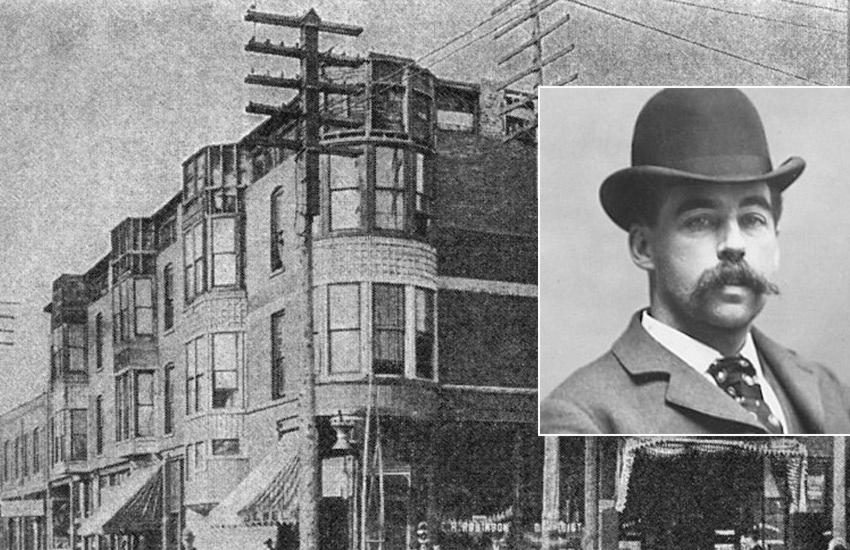
Holmes moved to Chicago in 1886 and started working as a clerk in Elizabeth Holton’s drugstore. He proved a model employee, and when Elizabeth’s husband died Holmes offered to buy the shop. Elizabeth accepted, and right after the deal was closed she mysteriously disappeared. To anyone who asked about her, Holmes replied that she had moved in with relatives in California.
Holmes kept working in the shop, where he sold water that he claimed could cure the sick. Once he had made enough money, he bought a plot of land opposite the shop and began building a hotel in time for the 1893 World’s Columbian Exposition. The hotel took up an entire block and had three floors. It was so big that people called it “the castle”.
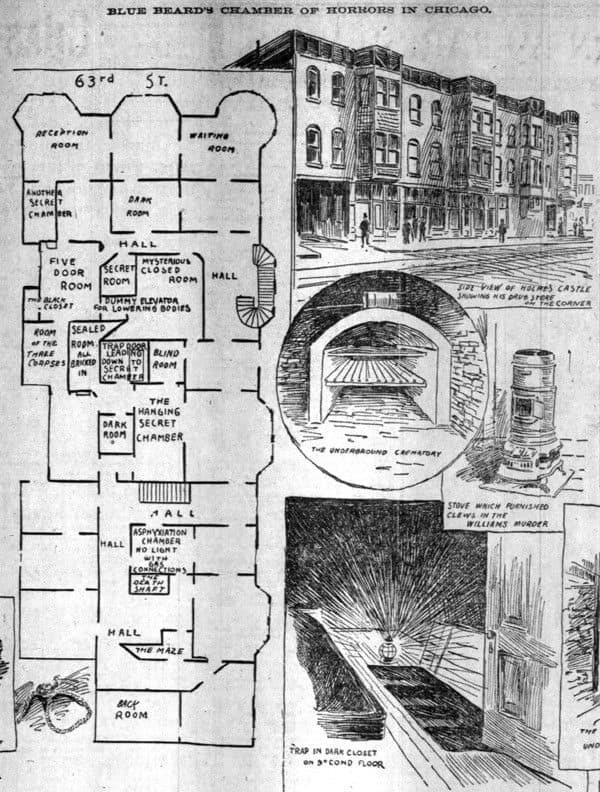
The inside of the castle was very strange: there were odd corners, hidden rooms and stairs that led nowhere. During construction Holmes constantly fired and hired workers. His goal was to be the only one who knew exactly how the castle was laid out. During the building work Holmes met Benjamin Pitezel, a carpenter with a criminal past who would help Holmes with his scams.
The death rooms
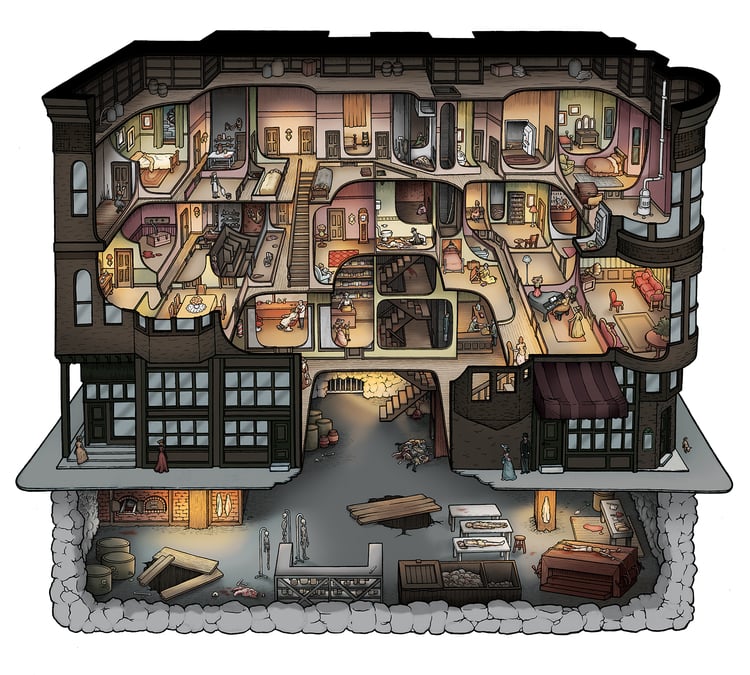
On the ground floor Holmes moved the shop he had been working in before building the hotel, while his office was on the first floor. But the building was in fact a death trap.
Some rooms had pipes running through them from which Holmes could release gas, killing his victims. Others had no doors, only trapdoors opening from the ceiling, through which Holmes threw the guests he wanted to kill, leaving them to die of hunger and thirst. Other victims were hanged in the “secret hanging room” or locked in the vault Holmes kept in his office.
All the rooms were soundproofed so that no one could hear the desperate cries for help, and an alarm system in the corridors told Holmes when someone was walking outside their room.
Holmes then took the bodies to the basement and sold the skeletons and some organs to medical schools, drawing on his contacts in the field. Or he disfigured them to collect life insurance payouts using his old scam. The bodies he had no use for ended up in a lime pit.
While still married to his three unsuspecting wives, Holmes began seeing a married woman with a daughter, who became his lover. When she got pregnant she asked Holmes to marry her. He agreed, but asked her to have an abortion, an operation he could carry out himself as a doctor. When she agreed, Holmes killed her. Later he also met Minnie Williams, a wealthy heiress. After tricking her into signing property over to him, Holmes killed Minnie and her sister.
The first arrest
In 1894 Holmes was briefly arrested for fraud. In prison he met the criminal Marion Hedgepeth, to whom he explained the plan for his next scam. Holmes wanted to take on a false identity, take out a life insurance policy naming his real identity as the beneficiary, and then produce a disfigured corpse to collect the payout. To do this he asked Hedgepeth for the name of a trustworthy lawyer in exchange for 500 dollars.
Once out, Holmes tried the scam but failed. He then asked for help from his old friend Pitezel, who agreed in exchange for half the money. Once the policy on Pitezel’s life was in place, Holmes killed him and claimed the payout. He then reassured the man’s wife, telling her that her husband had had to go into hiding in England, and took charge of three of their children. Later he killed all three.
Holmes kept travelling around the United States committing scams, but never paid Hedgepeth the 500 dollars, and Hedgepeth, angry, tipped the police off about his frauds.
Arrest and sentence
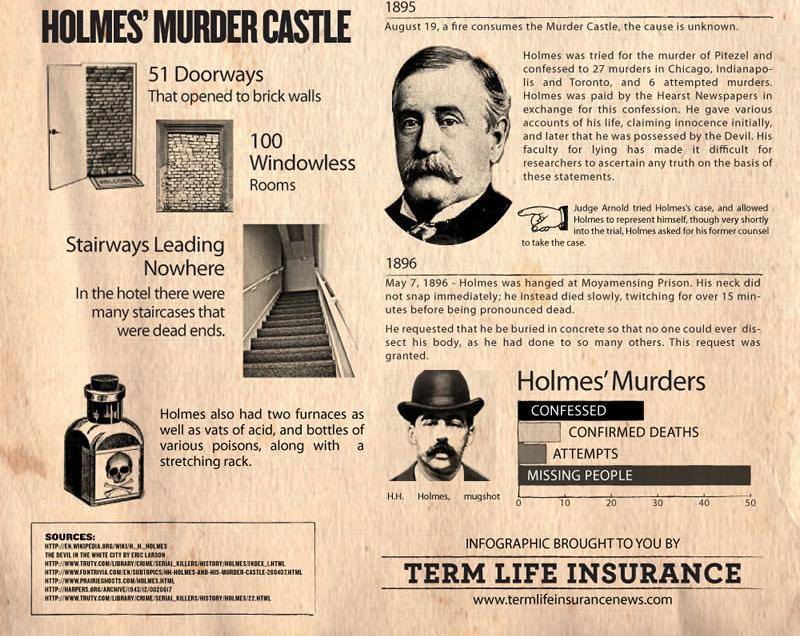
On 17 November 1894 Holmes was arrested in Boston, after being tracked by the Pinkerton detective agency, on an outstanding warrant for horse theft in Texas. While he was in custody, Philadelphia detective Frank Geyer retraced his movements: in July 1895 he found the bodies of Alice and Nellie Pitezel buried in the cellar of a house Holmes had rented in Toronto, and later the remains of little Howard in Irvington, near Indianapolis. At that point the Chicago police began searching his “castle”.
There they found all the torture chambers and the bodies in the basement. Besides the bodies they also found 2 furnaces, various containers of acid and even a wooden frame used to stretch and tear the victim’s body, like the “veglia” rope torture.
To their amazement, the police discovered that the hotel had 51 doors opening onto brick walls, stairs leading only to a wall and 100 rooms without any windows.
Holmes confessed to 27 murders, but he was a compulsive liar and some of the people he claimed to have killed were alive. He was sentenced to death for the murder of Benjamin Pitezel, and is also held responsible for the deaths of three of Pitezel’s children and some of his lovers.
He was executed by hanging on 7 May 1896. His neck did not break in the drop, so he slowly strangled to death, twitching for over 15 minutes before drawing his last breath.
Between fact and legend
Much of what is told about Holmes, including the figure of 200 victims and several details about the castle, comes from the tabloid papers of the time, which competed to publish the most macabre details. More recent research suggests the 63rd Street building was used mainly for business, and that its irregular layout served Holmes’s frauds more than his murders. The proven crimes remain, and they are enough to make him one of the most frightening criminals in American history.
🦋 Emadion lives through its readers. If this story kept you up at night, buy me a coffee: it helps me bring you the next nightmare.
☕ Support Emadion on Ko-fi