
 Posted by
According to the oldest sources, on 26 June 1284 some 130 children vanished from Hamelin, a small town in Lower Saxony, after following a mysterious piper. The rats only enter the story almost three centuries later. Nobody knows what really happened: mass emigration to the east, a natural disaster, a battle, or something the town never dared to write down.
In a library in Lower Saxony there is a fourteenth-century Latin codex, a collection of religious texts compiled by a Dominican friar from Minden. On the back of its last page, around the middle of the fifteenth century, a different hand added a few lines under a blunt heading: Fabula exodi Hamelensis, the story of the Hamelin exodus.
There are no rats in those lines. No greedy mayor, no unpaid fee. Just a date, an elegant stranger with a silver pipe, and a number that has never stopped weighing on the town: one hundred and thirty children.
The feast of Saints John and Paul
The text, now known as the Lüneburg manuscript, says that in 1284, on the feast of Saints John and Paul, 26 June, a young man of about thirty crossed the bridge over the River Weser and walked into Hamelin. He was handsome and so finely dressed that everyone who saw him stopped to stare. He began to play a strangely shaped silver pipe through the streets.
Every child who heard it, about 130 of them, followed him. They left through the town’s eastern gate towards the so-called Calvary, the place of executions. There, the anonymous writer says, they vanished without a trace. Their mothers ran from town to town and found nothing at all.
The account adds one unsettling detail: among those who saw the children leave was the mother of Johann von Lüde, dean of the town’s collegiate church. An eyewitness, then, or at least someone tradition treated as one.
A window, a chronicle and an inscription
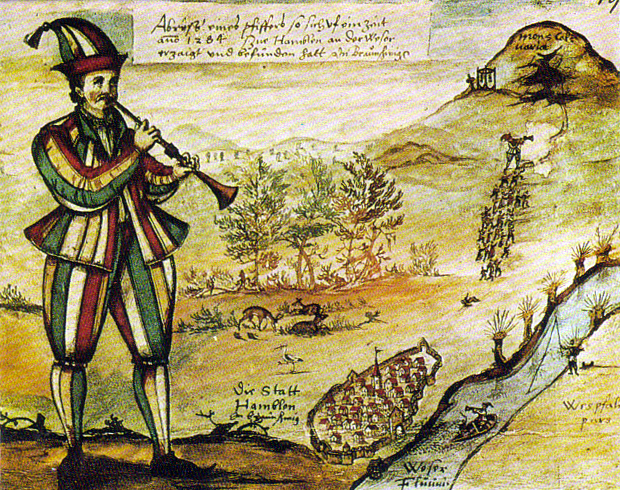
The Lüneburg manuscript is not the only trace. Hamelin’s Market Church, the Marktkirche, once had a stained-glass window made around 1300 showing a brightly dressed figure and a group of children in white. Visitors described it between the fourteenth and seventeenth centuries; it was restored in 1572 at the mayor’s expense and finally destroyed in 1660. A painted copy from 1592 survives and is considered the oldest picture of the Piper.
Several studies also report that the town records for 1384 contained a stark line: it is a hundred years since our children left. According to tradition, Hamelin even counted its years from that departure for a time, as if it were a founding date in reverse.
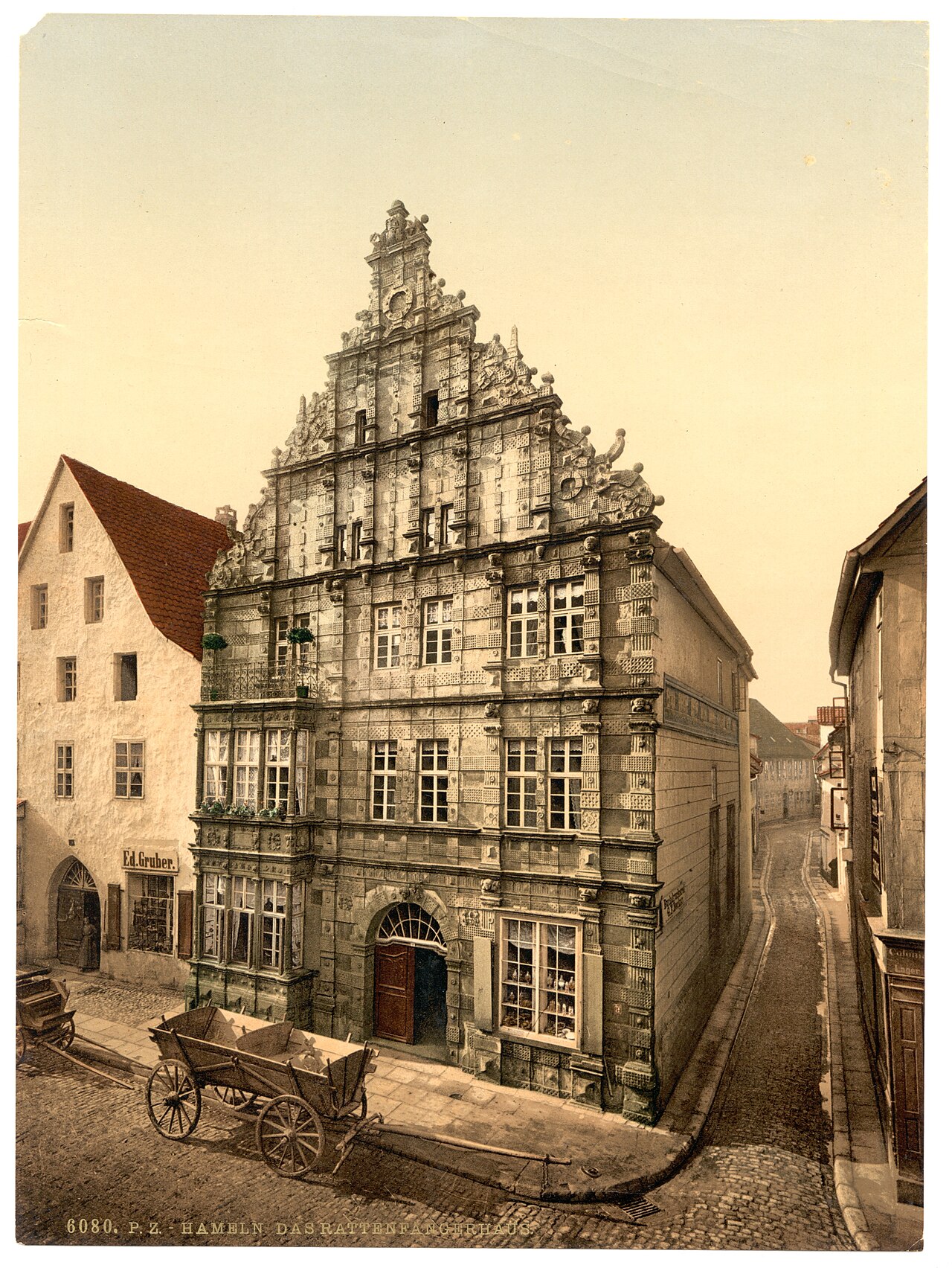
The town’s stones remember too. A fragment of the New Gate, built in 1556 and now displayed at the Hamelin Museum, carries a Latin inscription saying the gate was raised 272 years after a magician led 130 children out of the town. And on the façade of the so-called Pied Piper’s House, a Renaissance building put up in 1602 and 1603, you can still read that in 1284, on the day of Saints John and Paul, 130 children born in Hamelin were led away by a piper dressed in many colours to the Calvary near the Koppen, and lost.
Koppen is an old word for rounded hilltops. There are plenty of hills around Hamelin, and which one the legend means is still anyone’s guess.
First the Devil, then the rats
In the sixteenth century the story starts to change shape. In 1556 the writer Jobus Fincelius included it in a book of portents and blamed the Devil himself, who supposedly walked the streets in human form, whistling and luring boys and girls before vanishing with them into a hill. For Fincelius it was a terrible example of God’s wrath.
The rats only appear around 1565, in the chronicle of Count Froben Christoph von Zimmern. Here, for the first time, we meet the stranger who rids the town of rats with his pipe, the citizens who refuse to pay what they promised, and his revenge: the children follow him to a mountain that opens and closes behind them. German scholars in fact speak of two separate legends, the children’s exodus and the expulsion of the rats, that were only merged later.
The version everyone knows comes from the Brothers Grimm, who included it in their Deutsche Sagen in 1816: the rat-catcher in a coat of many colours, the rats drowned in the Weser, his return on 26 June while the adults are at church, and two children left behind, one blind and one mute, unable to show the way or tell what happened. In 1842 Robert Browning turned it into a rhyming poem, and the Pied Piper went global.
The street without drums
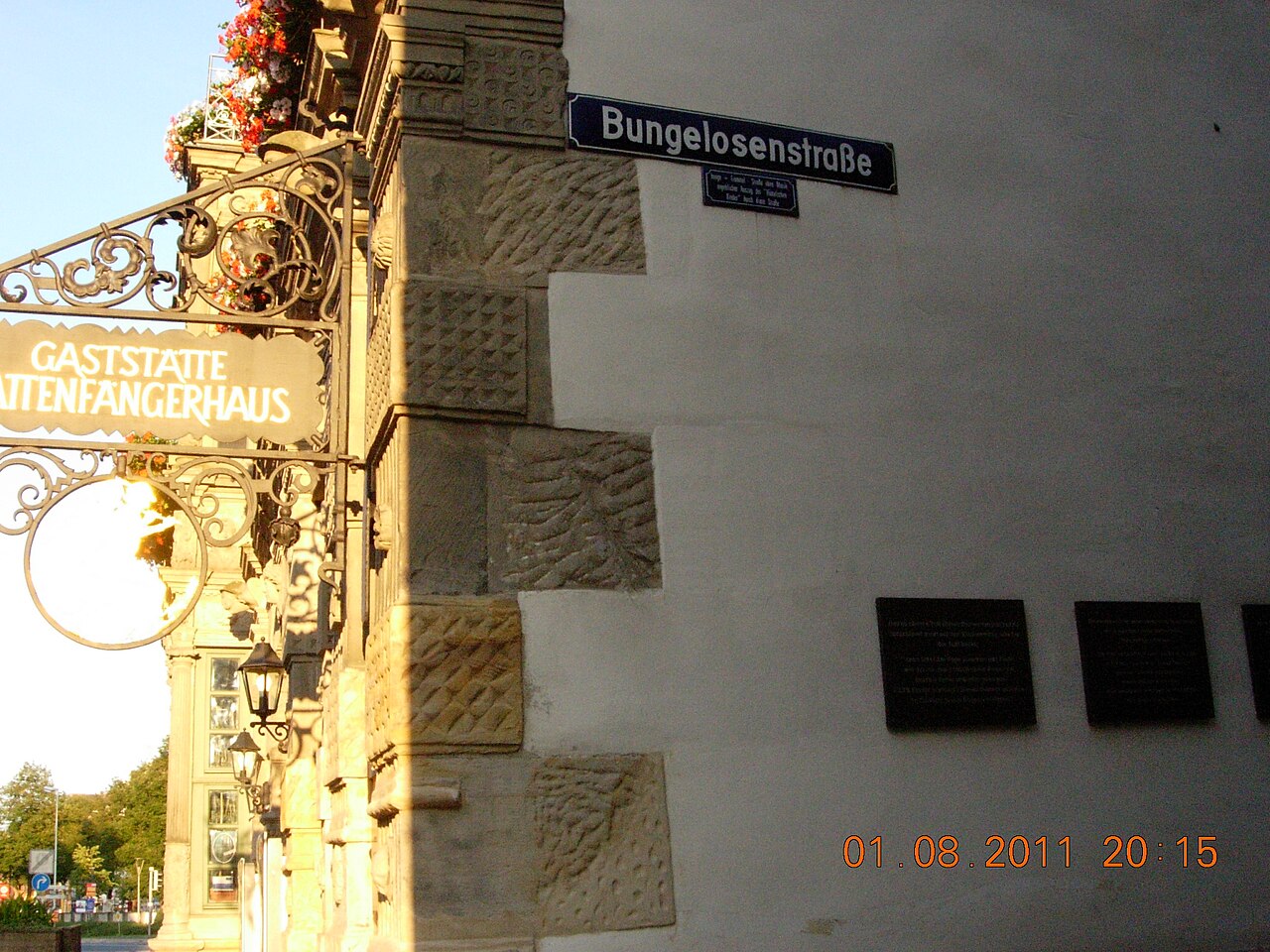
Next to the Pied Piper’s House runs a narrow lane, Bungelosenstraße, the “street without drums”. Tradition holds that it was the last place the children were seen, and that no one should play music or dance there ever since.
It is a telling detail: whatever happened in 1284, the town lived through it as a bereavement, not as a fairy tale.
What really happened to the children of Hamelin?
There are many theories and none has been proven. These are the main ones.
Emigration to the east. This is the explanation most historians now find likeliest, and the one the town of Hamelin itself favours. In the thirteenth century, lords of the lands east of the Elbe sent out recruiters, known as locators, to find settlers for new villages. They were often flamboyantly dressed and smooth-talking. In this reading the “children” were the town’s young people, the sons and daughters of Hamelin, who left together and never came back. Linguist Jürgen Udolph, studying place names, found names from the Hamelin area repeated in Brandenburg, in the Prignitz and Uckermark regions: Hamelspringe, for example, reappears as Hammelspring. Other scholars have pointed to Moravia, Pomerania or Transylvania, where a folk tradition claimed the lost children had climbed out of a cave.
A natural disaster. Others suspect a mass death: an epidemic, a drowning in the Weser, a landslide. A less common theory imagines the young people gathered for ritual dances in the woods near Coppenbrügge, whose name echoes the mysterious Koppen, and swept away by a landslide or a sinkhole. In this view the Piper would be a figure of Death, a cousin of the medieval danse macabre. The Black Death, however, only reached Europe in 1347, more than sixty years later.
A battle. As early as 1749 a Hamelin preacher, Christoph Friedrich Fein, linked the legend to a clash in 1259 between the townsmen and the troops of the Bishop of Minden, the Battle of Sedemünder, in which many young men from the town are said to have died.
A crusade or a collective mania. Some have pointed to the Children’s Crusade, though that dates to 1212, and others to the dancing manias that swept medieval Europe: in 1237 a large group of children danced and leapt their way from Erfurt to Arnstadt, about twenty kilometres. Something similar would strike a whole city on the Rhine centuries later.
A town that lives on its mystery
Today Hamelin has made the Piper its emblem. Every 26 June is marked as Rat Catcher’s Day, the legend is performed in the open air next to the Hochzeitshaus, the old wedding house, and a glockenspiel on the same façade replays its scenes. Since 2014 the traditions around the legend have been listed in Germany’s national inventory of intangible cultural heritage under the UNESCO convention.
And yet, behind the rat-shaped souvenirs, there is still that page in a manuscript where mothers run from town to town and find nothing. Seven centuries later, anyone who walks down Bungelosenstraße in silence is still honouring a grief whose cause no one truly knows. Perhaps the children of Hamelin became farmers in some Brandenburg village, and their descendants still carry surnames born on the Weser. Or perhaps the Calvary really did swallow them, as an old prayer from the town put it. Either way, the pipe has never stopped playing.
If medieval mass hysteria fascinates you, read about the dancing plague of 1518 in Strasbourg. And for another legend from the German-speaking world, discover the legend of the Krampus.
🦋 Emadion lives through its readers. If this story kept you up at night, buy me a coffee: it helps me bring you the next nightmare.
☕ Support Emadion on Ko-fiSources
- Pied Piper of Hamelin, Wikipedia
- Rattenfänger von Hameln, Wikipedia (German)
- Il pifferaio di Hamelin, Wikipedia (Italian)
- The Pied Piper of Hamelin, an unsolved mystery, City of Hameln
- The Medieval Mystery Behind the Pied Piper, Medievalists.net
- The Pied Piper of Hameln and related legends from other towns, D. L. Ashliman, University of Pittsburgh
Featured image: Das Rattenfangerhaus, Hameln, photochrom print (c. 1890-1900), Photochrom Print Collection, Library of Congress, public domain, Wikimedia Commons.
